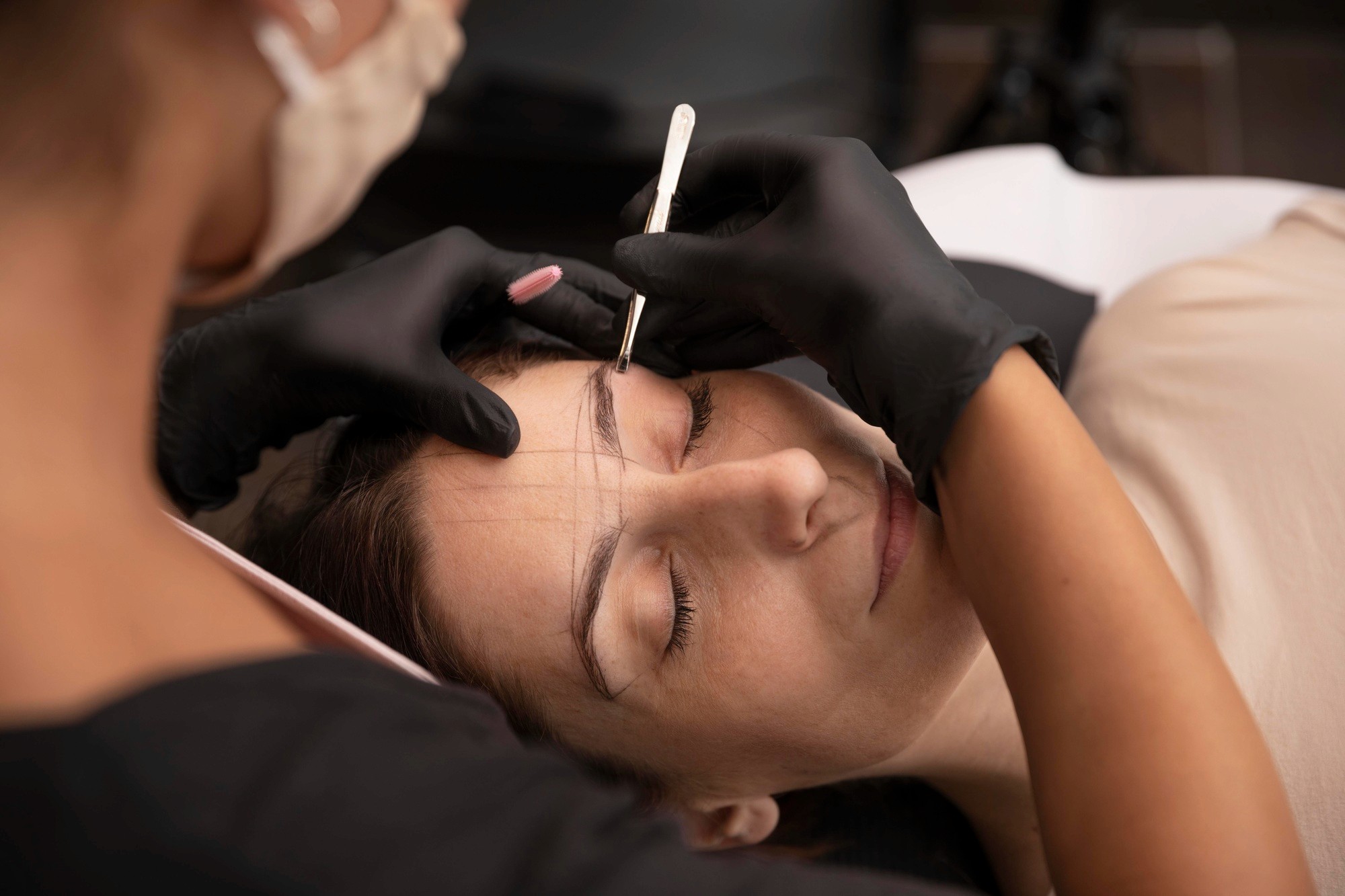
Eyebrows are a central element of facial expression. They not only highlight emotions but also create balance and harmony in facial features. In modern brow architecture, geometry plays a decisive role: lines, angles, and proportions are applied in a way that each brow is individually designed while enhancing the natural beauty of the face. At MONLIS School Munich, students learn how theoretical foundations of geometry are applied in practice to achieve perfect results.
The Importance of Geometry in Brow Architecture
Geometry is more than mathematics – it is a language of harmony. In eyebrow design, it helps determine the correct relationship between length, arch height, and thickness. Perfect eyebrows are never accidental; they are the result of precise line work and proportion, tailored to each individual face.
Fundamental Line Principles
The analysis of brows begins with three fundamental lines:
-
Start point of the brow – runs vertically from the edge of the nostril upward.
-
Arch height – determined by a diagonal line from the nostril through the center of the pupil.
-
End point of the brow – aligned by a line from the nostril through the outer corner of the eye.
These three lines form the basis of symmetry and balance. At MONLIS School, students practice these techniques both for natural corrections and artistic brow styling.
Proportions: The Face as a Reference
Every face is unique, yet proportions often follow certain patterns. The most famous is the “Golden Ratio” (1:1.618), used in art, architecture, and beauty. For eyebrows, the golden ratio appears in:
-
the relationship between length and height,
-
the harmony between forehead, eyes, and arch,
-
the balance between right and left brows.
At MONLIS School, students are taught how to apply this ratio to every face shape – whether oval, round, square, or heart-shaped.
Common Mistakes in Lines and Proportions
A lack of understanding of geometry often leads to disharmony:
-
Brows that are too short make the eyes look smaller.
-
An overly high arch can create a surprised or unnatural look.
-
Unequal start and end points break facial symmetry.
That is why MONLIS School Munich places strong emphasis on precise training and hands-on practice, ensuring graduates can work with absolute accuracy.
Practical Training: Geometry on Models
At MONLIS School, theory is always combined with practice. Students work with special measuring tools (such as brow liners and templates), sketch geometric outlines, and transfer them onto real models. This builds their skills in:
-
customizing brow shapes,
-
creating smooth transitions,
-
achieving symmetry even when facial features differ.
Thanks to this practical training, graduates not only master the basics but also gain the ability to create modern and artistic brow designs.
Why MONLIS School Is the Right Choice
The MONLIS School in Munich is one of the leading training centers in the beauty industry. With its focus on manicure, pedicure, and brow architecture, the school combines theoretical knowledge with practical skills. Students benefit from:
-
experienced instructors with international expertise,
-
modern training methods,
-
practice-oriented courses with real models,
-
a solid foundation in geometry and proportions that makes them sought-after professionals.
Eyebrow architecture is a combination of art, craft, and geometry. Lines and proportions form the foundation for results that are not only beautiful but also tailored and harmonious. At MONLIS School Munich, you will learn how to master these principles – transforming eyebrows into true works of art.