Ombre with chrome powder is considered one of the most technically demanding techniques in modern nail design. A metallic gradient looks refined and harmonious only when the choice of materials, application technique, and sealing are precisely coordinated. At the MONLIS School in Munich, this technique is taught not as a decorative effect, but as a controlled professional method with clear technical standards.
What Makes Chrome Ombre Different from Classic Gradients
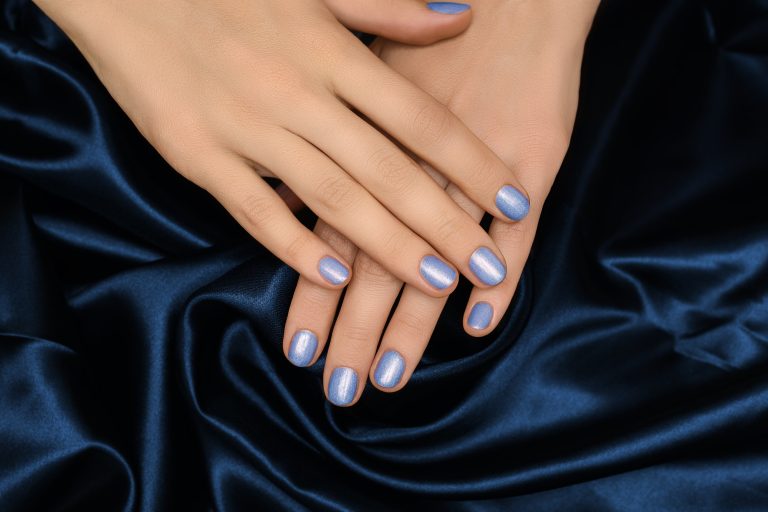
Unlike classic gel polish or airbrush ombre, chrome ombre is based on working with reflective pigments. The particles of chrome powder form a thin metallic layer on the surface and react sensitively to the base, pressure, friction, and top coat.
The gradient is created not by mixing colors, but by controlling the density of the pigment. This is what gives metallized blends their distinctive visual depth and at the same time makes the technique more demanding.
Choosing the Right Chrome Powder for Clean Transitions
Only finely milled, evenly reflecting powders are suitable for ombre work. Coarse or uneven pigments can create patchy transitions and interrupt the mirror effect.
In practice, specialists distinguish between:
– classic mirror chrome
– soft chrome with a satin effect
– colored metallic pigments
For smooth transitions, soft chrome powders are usually easier to control than highly reflective mirror finishes.
Base and Top Coat as the Foundation for Metallic Gradients
The quality of the gradient strongly depends on the base. A smooth, dust-free, and fully polymerized color layer is essential. Dark, even shades or dense nude bases provide the most stable background.
Chrome powder is applied to a no-wipe top coat or to a partially cured layer. The surface must allow the pigment to glide, but not spread uncontrollably.
Technique of Metallized Blending According to the MONLIS Method
The gradient is created by gradually rubbing in the pigment with controlled pressure. The highest shine is concentrated in the focal area, while the pigment density is softly reduced toward the edges. Precision and consistency are more important than speed.
Typical working steps include:
– picking up small amounts of pigment
– building the main reflective zone
– softly fading the edges by reducing pressure
– fixing the result without smearing the transition
The gradient must appear seamless, without visible lines or breaks.
Sealing and Protection of the Chrome Effect
The choice of top coat affects not only durability but also the visual depth of the metallic finish. Overly thick or highly elastic top coats can visually dull the mirror effect.
Clear, low-tension top coats with good self-leveling properties are recommended. Sealing should be done in thin layers to preserve the clarity of the metallic transition.
Common Mistakes in Chrome Ombre and Their Causes
Uneven results are usually caused not by the pigment itself, but by technical inaccuracies:
– overly coarse powder texture
– incorrect tackiness of the base layer
– uneven pressure during application
– top coat applied too thickly
These factors can lead to cloudiness, streaks, or irregular light reflection.
Why Chrome Ombre Is Part of Professional Training
Metallized gradients require a precise understanding of material behavior, surface tension, and light reflection. At the MONLIS School, these techniques are taught in connection with base preparation, layer control, and visual balance.
This approach develops not only technical skills, but also the aesthetic judgment of future nail professionals.
Key Points About Chrome Ombre According to MONLIS Standards
– Metallic gradients are created through pigment density, not color mixing.
– Finely milled chrome powders ensure smooth transitions.
– The base and top coat determine visual depth.
– Pressure control is essential for seamless blending.
– Professional technique prevents clouding and streaking.