Geometric nail art has become one of the most popular trends in modern nail design. It looks clean, stylish, and structured—and suits any nail shape, length, or occasion. But behind every perfect geometric design lies a well-planned, technically precise process. Only a correct, methodical approach allows you to achieve flawless symmetry, sharp lines, and a polished professional result.
At MONLIS Schule Munich, one of the leading training centers for manicure and pedicure, students learn the full methodology for constructing geometric patterns—from the very first guideline to the final sealed design.
This detailed guide shows how professionals build a geometric pattern step by step.
Why Geometric Designs Require Special Technique
Geometric patterns demand a high level of technical skill because they require:
– perfect symmetry
– clean and controlled line work
– accurate proportions
– precise tool control
Even a small deviation can make the design look unbalanced. For this reason, MONLIS Schule trains nail artists in hand stability, material knowledge, and visual accuracy.
Step 1 – Nail Preparation: The Foundation of Every Design
A perfect geometric pattern starts with a flawless nail surface. At MONLIS Schule, learners master:
1. Degreasing and smoothing the nail plate
– gentle buffing
– thorough dust removal
– cleansing with a nail prep solution
This prevents lines from spreading and ensures color adhesion.
2. Applying a smooth, even base color
Key rules:
– use self-leveling materials
– apply thin, even layers
– fully cure each coat
A clean, smooth base is essential for accurate pattern building.
Step 2 – Mapping: The Invisible Architecture of the Design
Before the design becomes visible, its structure is created underneath.
Sketching ultra-thin guidelines
Students learn how to:
– draw vertical and horizontal axes
– mark central and side points
– define the proportions of the final pattern
Checking symmetry
Using perspective and control points, artists verify that:
– both sides mirror each other
– angles are consistent
– distances between elements are balanced
Only after perfect mapping do they proceed to color.
Step 3 – Line Work: Professional Tool Mastery
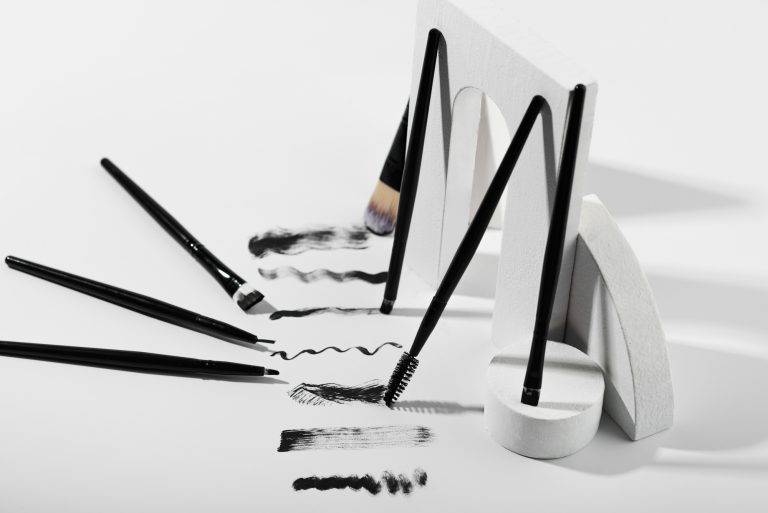
Flawless line work is essential for geometric designs. Tools include:
– liner brushes
– detail brushes
– dotting tools
– striping gels
MONLIS Schule technique:
-
Start by lightly sketching the line
-
Then refine and sharpen it
-
Apply minimal pressure to create perfect angles
-
Cure each segment to prevent smudging
This layered approach guarantees clean, sharp lines.
Step 4 – Building the Pattern: From Simple to Complex
Geometric nail art is constructed in layers.
1. Adding basic shapes
– triangles
– straight lines
– squares
– dots
2. Connecting elements
Students practice:
– correct spacing
– balanced composition
– harmonious shape transitions
3. Adding fine details
– micro-lines
– tiny accents
– shadow effects
– bold contours for depth
A structured build-up ensures the design looks clean, not overloaded.
Step 5 – Perfect Sealing: Long-Lasting and Polished
A geometric design must be sealed properly to look professional.
MONLIS sealing technique:
– apply top coat thinly and evenly
– cover all edges carefully
– seal the free edge
– cure fully without overheating
This keeps lines sharp and the design durable for 3–4 weeks.
Common Mistakes and How to Avoid Them
At MONLIS Schule, students learn to avoid:
1. Smudged lines
Cause: insufficient curing
Fix: cure after each line
2. Poor symmetry
Cause: skipping guidelines
Fix: always mark axes first
3. Uneven proportions
Cause: working too fast
Fix: build a clear base grid
4. Gel spreading
Cause: wrong product consistency
Fix: choose materials with correct viscosity
Why Students at MONLIS Schule Master Geometric Designs Perfectly
The training combines:
– precise technical instruction
– material science
– hands-on practice on models
– expert supervision and corrections
– individual learning pace and feedback
Graduates not only understand theory but also master true craftsmanship.
Geometric nail designs are elegant, modern, and professional—when built with precision.
At MONLIS Schule Munich, students learn a structured approach that leads from the first guideline to the final design with accuracy, harmony, and professional shine.