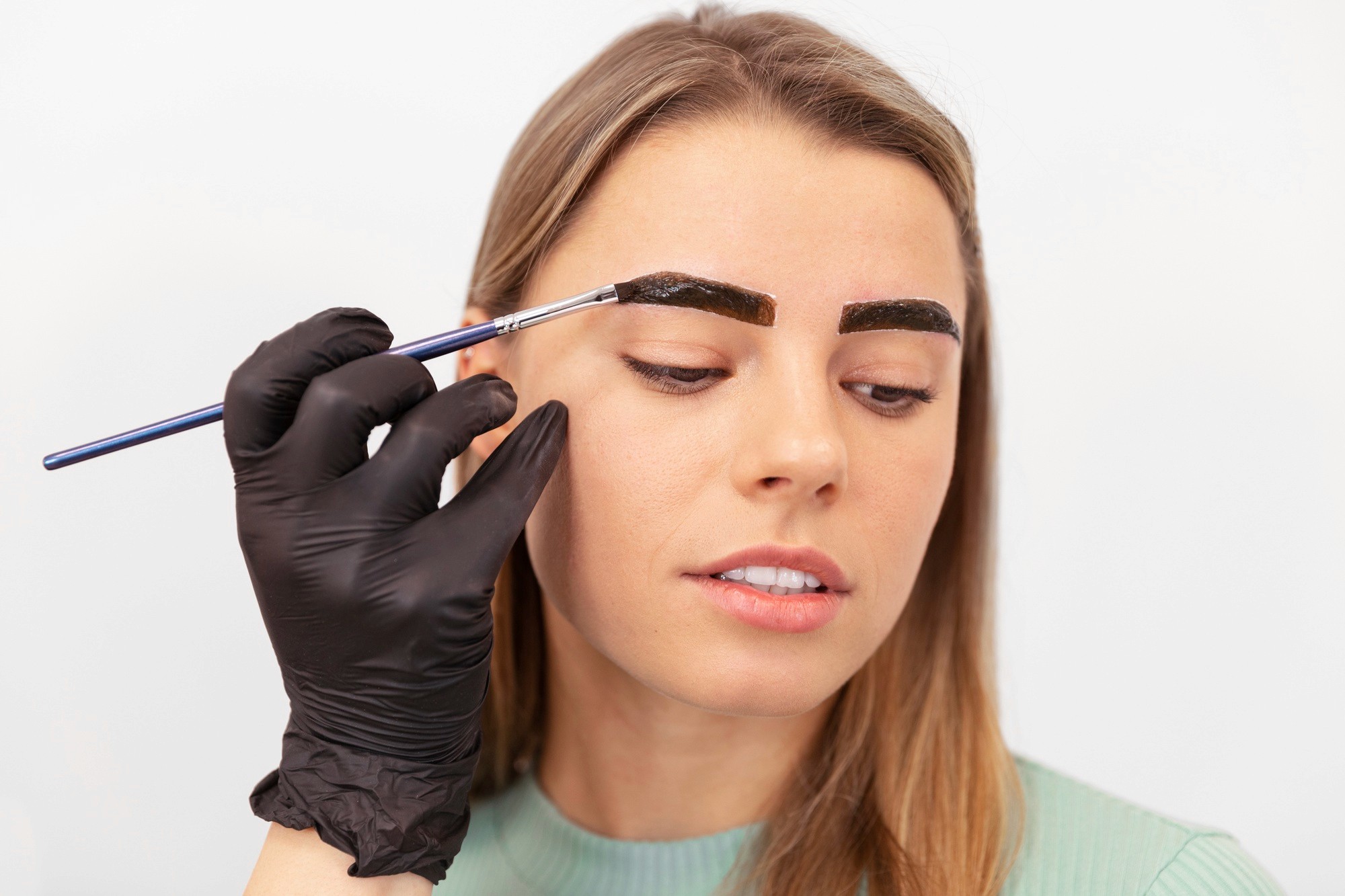
Working with previously tinted eyebrows is one of the most common, yet also more challenging, tasks in brow styling. Clients often arrive with residual pigments from past treatments, uneven color distribution, or a shade that has changed over time and needs correction. At MONLIS School in Munich, we teach future professionals the knowledge and techniques required to achieve optimal results in such cases – without damaging the hair structure or unintentionally intensifying the color.
1. Analyzing the Current Color State
The first step when working with pre-tinted brows is a thorough analysis:
-
Color tone: Is it cooler, warmer, or faded?
-
Pigment distribution: Even or patchy?
-
Hair and skin condition: Healthy, dry, brittle, or oily?
Pro Tip from MONLIS School: Always note which pigments and brands were used during the previous tint – this helps in adjusting the new formula more accurately.
2. The Impact of Residual Pigments
Residual pigments greatly affect the new tinting process.
-
Light residual pigments: Can serve as a base but may require a stronger color formula.
-
Dark residual pigments: Often need neutralizing before a new tint can be applied.
-
Uneven pigments: Require targeted, zone-specific tint application.
Here, knowledge of color theory and neutralization techniques is essential – a core focus in our training at MONLIS School.
3. Color Correction Instead of Over-Tinting
A common mistake with pre-tinted brows is “over-tinting” – applying a darker or overly saturated color to cover everything. This can result in an artificial, harsh look.
Instead:
-
Neutralize unwanted undertones (such as red or orange hues) with complementary shades.
-
Adjust processing time individually to avoid overly intense results.
4. Extra Care with Weakened Hair
Especially after laminations or frequent tinting, brow hairs can be more fragile.
-
Reduce processing time.
-
Use gentler developers (e.g., 1.8–3% instead of 6%).
-
Add nourishing ingredients to the treatment to prevent breakage.
5. Skin Preparation and Protection
The skin around the brows can be more sensitive due to repeated tinting.
-
Cleanse gently and avoid aggressive exfoliation right before the tinting process.
-
Apply protective cream along the brow edges to prevent skin staining.
6. Client Communication
With previously tinted brows, setting realistic expectations is essential.
-
Explain that some residual pigments cannot be removed completely in one session.
-
Discuss possible shades and the need for multiple appointments to achieve the desired outcome.
7. Training at MONLIS School
In our courses, you will learn how to:
-
Perform detailed color and hair analysis on pre-tinted brows
-
Apply professional neutralization and correction techniques
-
Adjust tint formulas for natural-looking results
-
Use gentle methods for sensitive skin and weakened hair
With these skills, you can confidently handle even the most complex corrections.
Working with previously tinted eyebrows requires precise analysis, solid knowledge of color theory, and experience with various hair and skin types. At MONLIS School in Munich, we provide the techniques to create harmonious, long-lasting, and gentle results – even in challenging cases – ensuring client satisfaction every time.