One of the most frustrating problems in professional and at-home manicures is the early lifting of nail polish – especially around the cuticle area. When a client notices peeling or detachment just a few days after a manicure, the question quickly arises: What went wrong?
At MONLIS School in Munich, we teach our students not only the art of beautiful nail design but also a deep understanding of product behavior, nail anatomy, and precise technique. In this article, we’ll explain why polish often lifts at the cuticle and what you can do – as a pro or beginner – to prevent it.
The Most Common Reasons for Lifting Near the Cuticle
1. Insufficient Preparation of the Nail Plate
If the nail surface isn’t properly degreased or cleared of skin particles, the polish can’t adhere well. Especially near the cuticle, invisible oils, dust, or moisture often accumulate and compromise the bond between product and nail.
2. Incomplete Removal of the Invisible Cuticle (Pterygium)
Pterygium is a thin layer of invisible skin that spreads onto the nail plate. If it’s not carefully and fully removed, the polish won’t adhere properly and will start lifting from the edges.
3. Applying Too Close to the Cuticle
A common mistake among beginners: applying polish too close or even onto the cuticle. When cured, the product won’t have a sealed edge, leading to early lifting.
4. Excess Contact with Oils or Skin Before/After Application
Creams, oils, or sweat on the skin negatively affect adhesion. Even applying cuticle oil or hand cream too soon after top coat curing can lead to lifting at the edges.
5. Incorrect Filing or Nail Plate Shaping
If the nail is unevenly filed or shaped too round, the product can’t adhere evenly. The cuticle area is particularly sensitive to such technical flaws.
How to Prevent Lifting at the Cuticle – Tips from MONLIS School
✅ 1. Thorough Nail Prep
-
Remove all residues using a professional cuticle pusher.
-
Use a dehydrator and, if necessary, a primer.
-
Lightly buff the surface – especially near the cuticle – to ensure proper adhesion.
✅ 2. Professional Removal of Pterygium
At MONLIS School, we teach safe and effective methods for removing pterygium without damaging the nail – ensuring optimal product bonding at the edge.
✅ 3. Proper Application Technique Near the Skin
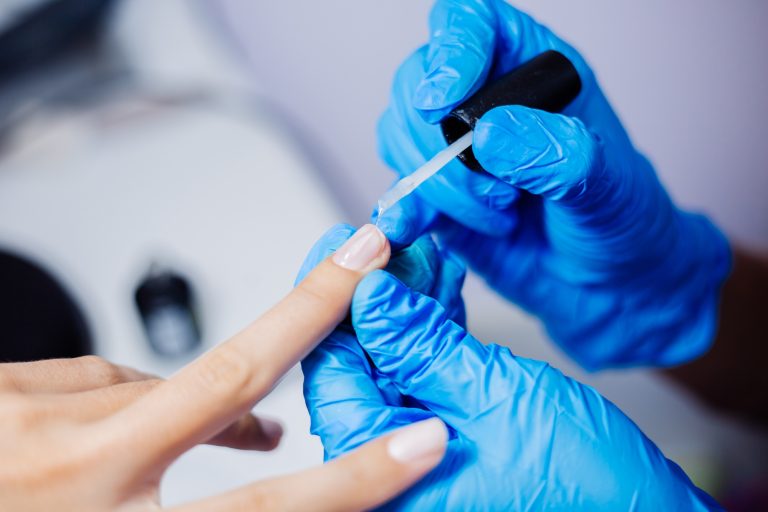
Leave a 0.5–1 mm gap between the product and the cuticle. Never touch the skin. This gap is crucial for long-lasting, clean manicures.
✅ 4. Use High-Quality Products and the Right Consistency
Choose high-quality base coats, colors, and top coats that suit the nail type. Avoid overly runny products that easily flood the cuticle area.
✅ 5. Steady Hand and Precise Work
Precision near the cuticle requires training. That’s why MONLIS School includes brush control and fine motor technique as part of its curriculum to help students achieve flawless results.
What to Do If the Polish Still Lifts?
-
Don’t apply polish over it! Instead, gently remove the loose area, clean it, and reseal it if possible.
-
Analyze the cause: Was the nail oily, moist, or overfilled with product?
-
Advise your client: Recommend avoiding creams or oils for at least 24 hours after the manicure.
Lifting near the cuticle is almost never random – it’s usually the result of improper prep or technique. At MONLIS School in Munich, we teach students how to avoid these common issues from the very beginning. Our focus is on precision, hygiene, and attention to detail.
With proper training, premium products, and a clear understanding of nail structure, you can create manicures that are not only beautiful – but also long-lasting and free from lifting or complaints.
Want to master the art of perfect adhesion and precision manicures?
Start your training at MONLIS School in Munich – with hands-on instruction, advanced methods, and one clear goal: perfection right up to the cuticle!