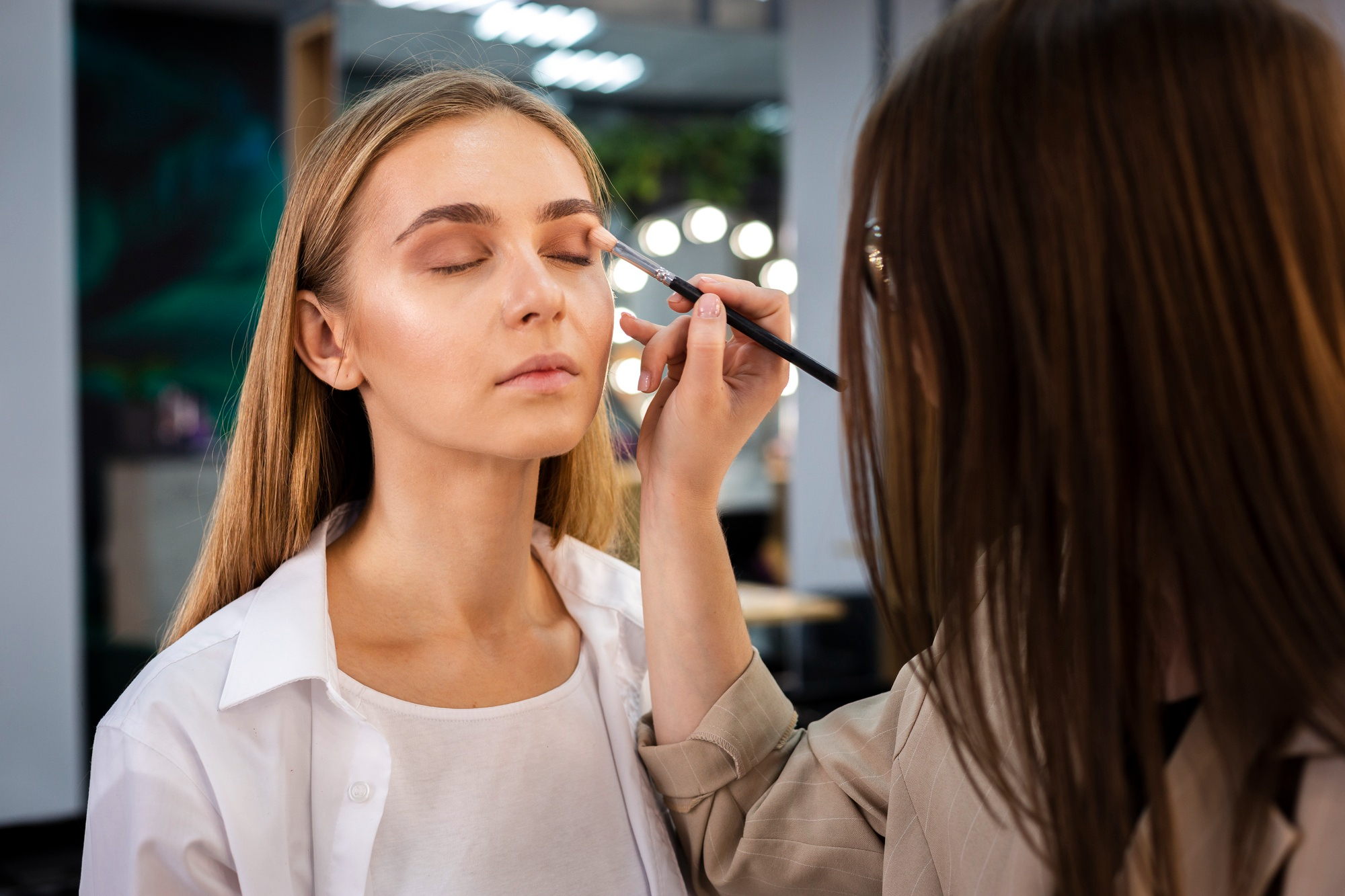
Anyone looking for a make-up course in Munich usually finds only offers online that take months and cost several thousand euros. In reality, the path to your own make-up technique is often much shorter: €230, one day – and you can start with your first client right after. For many, that sounds too simple to be true. Especially for women who are new to Munich or looking for a career change, one question matters more than the price alone: when will the money come back? That’s exactly what this article is about – what a one-day course actually teaches, how it compares to the long training paths, and what calculation makes the €230 pay off realistically.
Make-up Artist or Visagist – Is There Even a Difference?
Legally, no. Neither title is a protected profession in Germany, which means you don’t need a state qualification to call yourself either one and work with clients. Even a classic make-up artist training programme, which runs for years, isn’t a requirement to get started – it’s just one of several possible paths.
The difference is more about practice than law. “Visagist” is used more often for work with private clients – bridal make-up, events, in-studio consultations. “Make-up artist” is heard more often in the context of photo shoots, film, or fashion shows, where you work with lighting, cameras, and often tighter time constraints. In everyday language, the two terms blur together anyway. Hardly any client asks which title you carry. She asks whether the result works. Career guides confirm that this is an unregulated training path – anyone who wants to get started can, in principle, do so without a fixed educational programme.
This isn’t a minor detail. Getting started doesn’t depend on a diploma, but on whether you’ve mastered the technique and trust yourself to work with it. Many freelancers in Munich use both titles in parallel and simply adjust the wording to the client – for a bride it’s usually “visagist,” for a photo shoot enquiry it’s more likely “make-up artist.” For the actual work, it makes no difference.
What matters more than the title, then, is what you can actually do and how you demonstrate it. That’s exactly where course certificates come in: they don’t replace a state qualification, but they give clients and potential clients an initial sense that you’ve learned in a structured way.
Make-up Course in Munich Compared: 1 Day or Classic Training?
€230 versus several thousand euros, one day versus several years – that’s roughly the range on the Munich market. Which path fits depends on your goal, not just your budget.
| Format | Duration | Cost |
|---|---|---|
| 1-Day Course (MONLIS) | 1 day | €230 |
| Private school (e.g. Cambio, Famous Face Academy) | a few weeks to 12 months | approx. €2,700–€6,000 |
| HWK further-training exam | exam, usually with a preparatory course | €440 exam fee plus preparation |
| Dual vocational training (beautician/make-up designer) | 3 years | vocational school + employer, usually with a training wage |
Model calculation based on typical market prices; individual schools often quote exact prices only in a personal consultation.
Dual vocational training as a beautician or make-up designer runs for three years – the long, state-recognised path, including vocational school and on-the-job training. Private schools offer shorter programmes, but they come with their own price tags: Cambio Beautyacademy in Munich doesn’t publish prices for its make-up artist training publicly – they depend on course length and scope and are only given in a personal consultation; a comparable make-up artist programme at Cambio recently cost around €2,680 for a five-month programme. As a nationwide comparison: Famous Face Academy in Frankfurt am Main charges around €5,900 for its five-month part-time programme. Anyone who instead wants a state-regulated qualification can take the “Geprüfte/r Make-Up Artist – Visagist/in (HWK)” further-training exam at the Munich Chamber of Skilled Crafts – provided they hold a completed qualification as a beautician or hairdresser, or can show at least four years of relevant professional experience. The exam fee is €440, with preparatory courses usually coming on top. Overall, the market for “getting into the profession” ranges from €200 to €10,000, depending on how deep someone wants to go, according to industry sources.
One day isn’t enough for everything three years of training cover – anatomy, skin types, special cases, teamwork within a business. But most people looking for a one-day course don’t want that either. They want a solid basic technique they can put to use right away.
The price difference between formats comes down mainly to scope. A three-year training programme covers a complete profession, including exams, workplace practice, and often related subjects like skincare or manicure. A several-month private programme like Cambio’s or Famous Face Academy’s focuses more on make-up but is still a programme with modules, repetition, and its own practice materials. The one-day course, by contrast, is deliberately narrowed to a single, clearly defined slice: the basic technique for day and evening make-up. Anyone looking for exactly that slice only pays for that slice – not for a multiple of content they likely won’t end up needing.
What Will You Actually Learn in MONLIS’ One-Day Course?
The one-day make-up course at MONLIS covers exactly this basic technique: fundamentals of day and evening make-up, plus confident handling of colours, textures, and tools – that’s what fits into a single day. Enough to practise right afterwards or take on your first clients.
The schedule is deliberately lean and very hands-on. A short theory segment at the start – recognising skin types, matching colour temperatures, which product works for which occasion – makes up about ten percent of the day at MONLIS. The rest is practised directly on a model: basic foundation technique, contouring, matching eyeshadow to eye shape and occasion, plus the difference between a subtle daytime look and an evening look with more coverage and intensity. At the end, you receive a MONLIS certificate confirming you’ve mastered the basic techniques.
A key building block is working with brushes and sponges: which tool for foundation, which for concealer, which for soft eyeshadow blending. Anyone who’s practised this once under guidance loses the uncertainty that usually comes up with your first clients much faster.
What the course doesn’t cover: years of hands-on experience, specialising in bridal make-up with elaborate long-wear techniques, or preparing for photo shoots under professional studio lighting. Advanced formats exist for that. The one-day course is the entry point, not the end of the learning curve.
How Quickly Does the €230 Course Pay Off?
Freelance make-up artists in Germany typically charge around €50 for a daytime look, around €70 for an evening look, and between €150 and €200 for bridal make-up. Calculating with an average price of €50 per session, the €230 course fee is recovered after around five appointments. Anyone who focuses right away on occasions like weddings or parties could break even with just two bookings.
This is a model calculation based on typical market prices, not a promise of a specific income – how many clients you actually gain depends on demand, region, and your own presentation. Anyone interested in concrete salary ranges in the profession can look this up in common industry salary comparisons.
Two calculation paths show the range: someone offering only daytime make-up at around €50 needs about five appointments to recoup the €230. Someone who focuses early on occasions like weddings, at an average price of €175 per bridal booking, breaks even after just two jobs. The realistic expectation usually sits somewhere in between – a mix of everyday bookings and occasional larger events that adds up over the first weeks and months, rather than in a single weekend.
Who Is the Course Right For – and Who Isn’t It For?
For personal use – improving your own technique, doing make-up for friends or family, feeling more confident yourself – one day is often enough to make a real difference. It’s also a realistic starting point for a first step into freelance work alongside another job: you learn the basics, gain experience with real clients, and decide afterwards whether to go deeper.
On the other hand, anyone who wants to work long-term on set, specialise in special-effects or editorial shoots, or hold a state-recognised qualification and formally become a make-up artist, can’t get around longer training. The one-day course isn’t a substitute for that – at most, it’s a good first test of whether the work suits you at all.
Anyone still unsure whether make-up is even the right career path risks considerably less with €230 than with a several-month training programme costing several thousand euros. If the course reveals that working on your own skin or other people’s faces doesn’t bring the expected enjoyment after all, the financial loss stays manageable. If the opposite turns out to be true, there’s a clear next step: go deeper, specialise, or start straight away with your first clients.
Next Steps After the Course
With your MONLIS certificate in hand, you have two options: stay at this level, or build on it. Anyone who notices that make-up is only part of what interests them can go deeper into related areas – for example, a brow-lamination course or an eyelash-extension course. Both are frequently booked together with make-up, because clients like all-in-one packages.
But the most obvious next step remains the make-up course at MONLIS itself, with fixed dates in Munich and instruction in German, Ukrainian, or Russian.
The language question in particular matters more to many participants than it might seem from the outside. Anyone still unsure in a new language often loses time and focus in a German-language course – not because the technique is too difficult, but because everything has to be translated in parallel. Learning in your native language removes that detour and leaves more room for actual practice on the model client.
A make-up course in Munich doesn’t have to take months or cost thousands of euros. In just one day, you learn the fundamentals you can apply right away – whether for yourself or as a first step into a new career direction. Anyone who wants more – specialisation, a state qualification, work on set – needs a longer path. Anyone who wants to get started quickly and realistically earn back the cost will find a solid entry point in the one-day format. An overview of all MONLIS courses is available on the school’s homepage.
This article is for general information purposes only and does not replace advice from a qualified professional on taxation, business registration, or individual career planning.