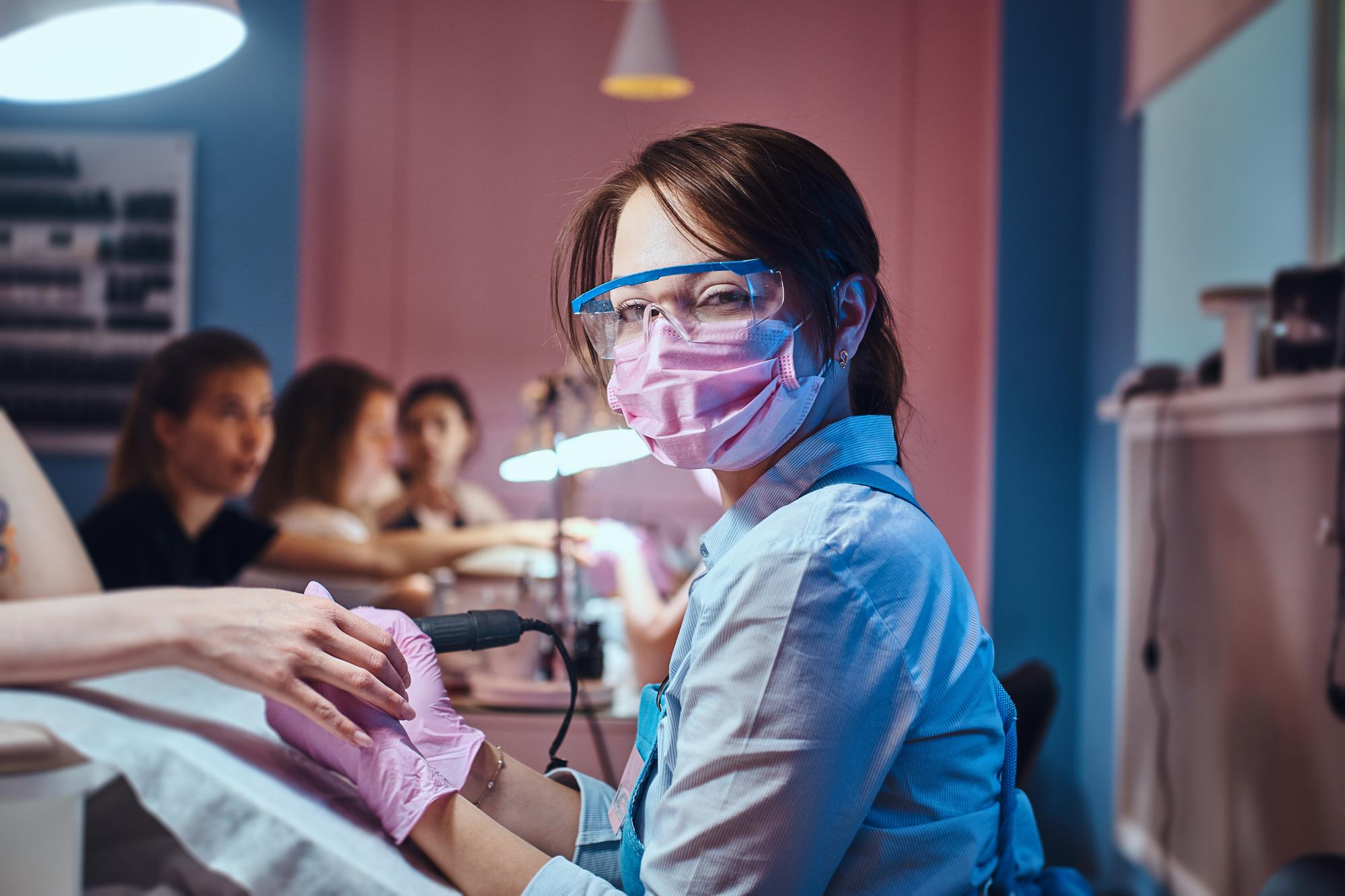
There is no state licence required to work as a nail technician in Munich. That is a fact. But it does not mean you can simply buy a nail kit and start charging clients the following week — without any documentation. There are two mandatory steps, without which you risk fines and complications with the tax office. The good news: both take far less time and money than most people expect.
This article offers a clear step-by-step roadmap: what replaces a licence in Germany, which nail technician certificate in Munich employers actually value, how to register a business, and where to learn without a language barrier. The market for nail services in Bavaria is growing steadily — and Munich remains one of the most promising cities in Germany for nail professionals.
Is a State Licence Required to Work as a Nail Technician in Germany?
No. Nail design in Germany is a so-called free (unregulated) profession. The state requires neither a state diploma nor mandatory master craftsman status (Meisterzwang) nor a special permit. Under the Gewerbeordnung (GewO) — Germany’s primary law governing commercial activity — nail design falls under free trades.
This is a fundamental difference from many other countries, where state certification for nail technicians exists. In Munich, no such document exists — and no one will ask you for it.
There is, however, an important nuance that is often overlooked. The absence of a licence does not mean the absence of rules. It means that responsibility for the quality of your work, the safety of your clients and compliance with hygiene standards rests entirely with you. Without a Gewerbe (business registration), charging clients for nail services is illegal — even if you work from home and only for acquaintances.
So What Replaces a Licence? The Role of a Certificate and Documents
Short answer: a certificate from a recognised school plus a registered Gewerbe — that is the complete foundation for starting out in Munich.
Clients and employers cannot check for a state licence — because it does not exist. They look at two things: your practical skills and a document confirming that you trained at a specific school. Some salons ask “Where did you train?” before the first interview.
Not all certificates carry the same weight. There is an official qualification — Geprüfte/r Nageldesigner/in from the Handwerkskammer (HWK) — but it requires a prior apprenticeship as a hairdresser or cosmetician. For most beginners, this is not a realistic option from the start. If you are interested in the foundations of the field, take a look at the article on the basics of manicure and pedicure — it will help you get your bearings before your first course.
For employed or self-employed work, a certificate from an accredited private school is sufficient. The key is that the school has a strong reputation in the market and that the certificate confirms real practical training — not merely attendance at a seminar.
Step-by-Step Plan: How to Start Legally as a Nail Technician in Munich
Step 1. Complete Training and Obtain a Certificate
First and foremost: practical skills and a supporting document. Choose a course that issues a certificate upon completion and includes real hands-on practice — not just theoretical lectures.
For those just starting out, the ideal option is a foundation nail course lasting 1–3 days. That is enough to meet your first clients and understand whether this field suits you. If you already have some experience, one-day advanced courses are available.
View the schedule and enrol: schule.mon-lis.de
Step 2. Register a Gewerbe (Business Registration)
Without this step, any payment from clients is illegal — even if you work from home. A Gewerbe is registered at the Gewerbeamt (KVR — Kreisverwaltungsreferat) in Munich. The registration fee is approximately 50–60 € according to the city’s official rates.
After registration, the Finanzamt will automatically send your Steuernummer (tax number). This usually takes a few weeks, but you can begin trading from the date of application.
Step 3. Become an IHK Member
After registering your Gewerbe, the IHK (Industrie- und Handelskammer) will contact you automatically. For a nail studio, membership is with the IHK — not the HWK (Handwerkskammer) — an important detail that is frequently confused. For first-time founders, IHK München waives membership fees for the first two years (provided income does not exceed €25,000 and you have not been self-employed in the past five years).
Step 4. Register with the Berufsgenossenschaft
The Berufsgenossenschaft Kosmetik und Fußpflegebetriebe Deutschlands e.V. is a mandatory insurance registration for all those opening a business in the cosmetics sector. The Gewerbeamt may forward your details automatically, but to be safe we recommend contacting the Berufsgenossenschaft yourself directly after registering your Gewerbe.
Step 5. Address Hygiene Standards and Liability Insurance
Bavaria is known for strict enforcement of Hygienevorschriften (hygiene regulations). Familiarise yourself with the requirements for your workspace, tools and disinfection — inspections genuinely happen here.
Betriebshaftpflichtversicherung (business liability insurance) is not legally required, but it is strongly recommended. If a client suffers harm during a session, you bear all costs personally without coverage.
Where and How to Learn — Options in Munich
There are two main paths.
A long-term Ausbildung lasts three years and results in a state diploma. It suits those who are ready to invest the time and who already speak German well. For most people who have recently moved to Munich, this is not a realistic option in the next one to two years.
A course at a private school lasts one to several days, is practice-oriented and ends immediately with a certificate. A realistic start: you can meet your first clients within a week.
And there is one more point that is rarely discussed openly: the language of instruction. If you are learning with material you do not fully understand, part of the knowledge simply does not stick. Learning in your native language removes that barrier entirely.
MONLIS Schule — a beauty school in Munich offering instruction in Ukrainian and Russian. Foundation nail course: three days (typically Friday–Sunday), 10:00–18:00, course fee €750 including materials. On completion — a certificate backed by practical skills. For those who already have a foundation, there is a one-day advanced course ‘Fortbildung Nagelstylist/in’. Current trends in nail design are also covered in the programme — so you know from day one what clients value.
View the schedule and sign up for the nail course: schule.mon-lis.de
How Much Does a Nail Technician Earn in Munich?
Munich is one of Germany’s most expensive cities — both for clients of beauty services and for professionals in terms of income. Actual figures depend on how you work.
An employed beginner can expect approximately €1,800–2,200 gross per month. That is the starting point without a personal client base or large portfolio. An experienced nail technician with their own regular clients earns approximately €2,500–3,000 and above — depending on client base and working format. Studio owners are a separate conversation: everything depends on turnover and team.
Figures are indicative and may vary significantly depending on experience, number of clients and working format.
One Munich-specific thing worth knowing: demand for nail services is highest in the evenings and at weekends. This is both a challenge and an advantage. A flexible schedule allows you to combine nail work with other employment early in your career — while your client base is still small.
On the question of “open a studio straight away or work as an employee first?” — for most people it makes more sense to start as an employed nail technician or self-employed from home. This allows you to build real experience, understand the market and develop your own client base without the risks associated with rent and a team.
Five Mistakes to Avoid at the Start
- Charging clients without a Gewerbe. Even “just a little” and “only from friends” is a violation. Fines are real.
- Choosing a course based solely on price. A cheaper course from a school with no reputation can produce a certificate that convinces nobody. Ask exactly what is in the programme and how much hands-on practice is included.
- Ignoring hygiene regulations. Bavaria is not a place where inspections are a formality. Tool disinfection, workspace requirements — learn these before your first client arrives.
- Assuming a foreign nail certificate is automatically recognised in Munich. Foreign qualifications are not automatically recognised. Employers check practical skills — and a document from a local school makes the conversation considerably easier.
- Starting independent practice without liability insurance. Betriebshaftpflichtversicherung costs little each month, but protects against situations that can cost far more.
A licence is not required — but there is a clear sequence of steps: training with a certificate, Gewerbe registration, IHK membership, Berufsgenossenschaft registration and compliance with hygiene standards. For those who have just moved and want to enter the beauty industry without a language barrier, there is a concrete solution: learn in your native language, obtain a nail technician certificate in Munich and take your first steps in a comfortable environment.
If you are looking for where to get a nail technician certificate in Munich and quickly start meeting clients — MONLIS Schule runs the foundation course over three days. Instruction in Ukrainian and Russian. View the schedule →
This article is for informational purposes only. For legal questions regarding business registration in Bavaria, we recommend contacting the relevant authorities or a qualified adviser.


