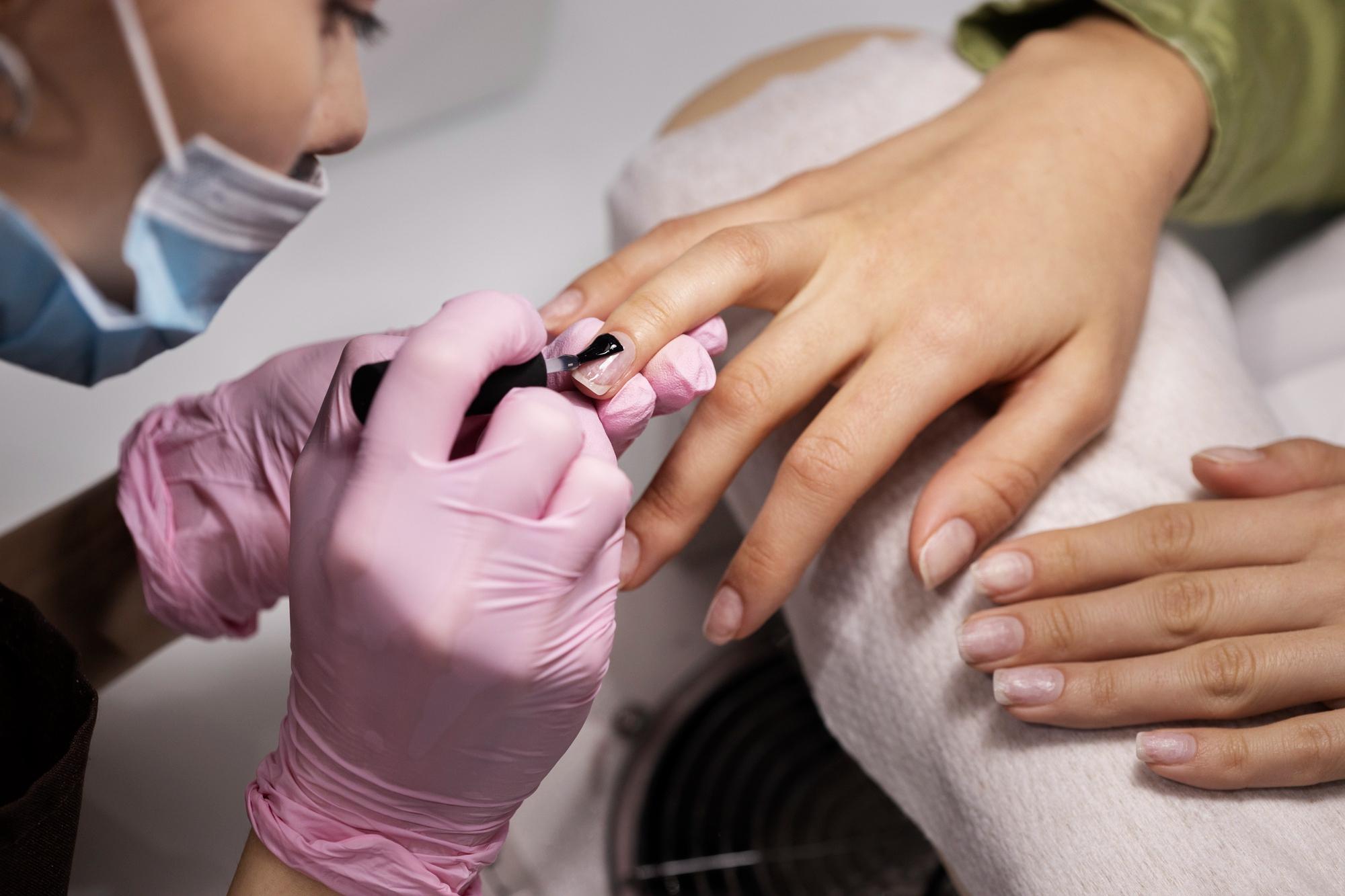
You already know how to do nails — or you’ve just finished a course. Your first clients are ready, the motivation is there. Starting without official registration in Germany means a potential fine of up to €1,000. The good news: registration is simpler than it sounds — two steps, one visit or an online form, a government fee of €45–65 — and you’re legally accepting clients. This guide will take you from the first document to the Gewerbeschein in your hands, with specifics for beauty professionals and Ukrainian nationals with § 24 AufenthG.
No certificate yet? The manicure course in Munich can be completed in 1–3 days — and you can put this guide into practice straight away.
What is a Gewerbe and do I need one as a beauty professional?
Short answer: yes — and it’s less daunting than it sounds.
A Gewerbe is the official registration as a self-employed person (Einzelunternehmer — sole trader). For beauty services — manicure, pedicure, lash extensions, brow styling, make-up — this is a Gewerbe, not a freier Beruf (liberal profession). Liberal professions in Germany include doctors, lawyers and architects — occupations with special educational status. Beauty professionals do not fall into that category.
There’s an important distinction for the beauty industry: unlike hairdressers, who require a Meisterbrief (master craftsman certificate), for manicure, lashes and brows no special licence is required. A course certificate raises your value in the eyes of clients but is not a legal requirement for registration.
“What if I only do nails for a friend in exchange for a small fee?” — a common question. If it happens regularly and payment is involved, that’s already commercial activity. Even if you work from home and “just for friends” — registration is mandatory before the first paying client.
Who can register a Gewerbe — and what about the Aufenthaltstitel?
EU citizens register without additional permits. If you are a Ukrainian national with § 24 AufenthG — you also have the right to self-employment, here’s why.
- 24 AufenthG (“temporary protection”) includes the standard entry “Erwerbstätigkeit gestattet” or “Erwerbstätigkeit erlaubt”. This entry covers both employed work and selbständige Tätigkeit — i.e. independent commercial activity. No separate permit from the Ausländerbehörde is needed to open a Gewerbe. The validity of § 24 has been extended until 4 March 2027 (EU Implementing Decision 2025/1460, Bundesrat decision of 17 October 2025).
| ⚠️ Important: This status applies primarily to Ukrainian citizens and persons who held permanent residency in Ukraine as of 24.02.2022. If you held only temporary residency in Ukraine and are not a Ukrainian citizen — your situation may differ. Check your status with the Ausländerbehörde. |
One thing to check: before going to the Gewerbeamt, open your Aufenthaltstitel and find the Nebenbestimmungen section (additional conditions). If there are specific restrictions — such as “Beschäftigung nur bei [employer]” or a prohibition on self-employment — contact the Servicestelle für Zuwanderung und Einbürgerung (KVR München) before registering. Such cases are rare, but worth checking.
What to prepare before registration
Three things to sort out in advance — before filling in any form.
Business address. Most professionals start from home — this is perfectly legal. Your flat’s address is listed in the Gewerbeanmeldung as the place of business. Check your tenancy agreement: some landlords prohibit commercial activity in the flat. If there is a prohibition — either agree in writing with your landlord or list the address of a rented studio.
Kleinunternehmer or not? The Kleinunternehmerregelung (§ 19 UStG) is a simplified tax regime for businesses whose annual turnover does not exceed €25,000 (new threshold from 2025, raised from €22,000). Under this regime you do not charge VAT to clients and do not file quarterly VAT returns. For a beginner, almost always the right choice. Indicated when filling in the Fragebogen at the Finanzamt.
BayernID for online submission. If you plan to register online, create an account on the BayernID portal in advance. An eID (electronic passport) is not required — email registration is sufficient.
Documents you will need:
- Passport or ID card
- Aufenthaltstitel (for non-EU citizens)
- Anmeldebestätigung — registration certificate for Munich (issued by the Einwohnermeldeamt)
- Completed Gewerbeanmeldung form
And a practical point straight away: what to write in the “Gegenstand des Gewerbes” field (nature of business). Don’t just write “Kosmetik” — that’s too vague. List exactly the services you actually provide:
| 💡 “Kosmetische Dienstleistungen: Maniküre, Pediküre, Wimpernverlängerung, Augenbrauen-Styling” — If you add a new service later, you can update the details via the Gewerbeamt (Gewerbeummeldung). |
Step 1 — Gewerbeanmeldung: online or in person at the KVR
Munich’s Gewerbeamt offers two equally valid options.
Online — easier and faster
Go to the official Gewerbeamt portal (www17.muenchen.de/gewerbe), log in with BayernID and fill in the form — this takes about 15 minutes. If you are not an EU citizen, upload a scan of your Aufenthaltstitel. The fee is paid online — €45–65 depending on the business type. After submission the KVR usually processes the application within 3–7 working days. The Gewerbeschein will arrive by post; until you receive the physical document, keep the portal confirmation — it has legal validity.
In person — if you need the Gewerbeschein the same day
| Address: | Implerstraße 11, 81371 München (Kreisverwaltungsreferat, Hauptabteilung III) |
| Metro: | U3/U6 Implerstraße or Poccistraße |
| Phone: | +49 89 233-96030 |
| Online appointment: | stadt.muenchen.de/gewerbeamt |
When visiting in person the Gewerbeschein is issued on the spot. However, an appointment must be booked in advance — same-day slots are rarely available. A duplicate Gewerbeschein (Zweitschrift) costs an additional €20 — order it straight away if you know you’ll need it.
| ⏰ The Anmeldung must be submitted before starting your activity or on the day of your first client. Fine for late registration — up to €1,000. |
Step 2 — Registration with the Finanzamt
After submitting the Gewerbeanmeldung, the KVR automatically notifies the Finanzamt. However, this does not mean your tax registration is completed automatically. You need to fill in the Fragebogen zur steuerlichen Erfassung — the tax registration questionnaire — yourself.
This is done through the official portal ELSTER (elster.de). Register there — important: the activation code arrives by post, so from registration to login takes 5 to 14 working days, sometimes up to 3 weeks. Start this in parallel with preparing your Gewerbeanmeldung, not after. Once logged in: “Formulare & Leistungen” → “Fragebogen zur steuerlichen Erfassung”. You can also indicate the Kleinunternehmerregelung there — and then no VAT is charged.
The Finanzamt will send your Steuernummer by post — usually within 2–6 weeks. Without the Steuernummer you cannot issue official invoices to clients. Deadline for submitting the Fragebogen: 1 month after commencing activity.
What happens after registration — IHK, insurance and more
After registering your Gewerbe, three processes start automatically: IHK notification, Finanzamt notification and (if applicable) a review of your insurance status.
IHK (Industrie- und Handelskammer). The Gewerbeamt automatically sends data to the Munich Chamber of Commerce — you will soon receive a welcome letter. New entrepreneurs without self-employment experience in the past 5 years are exempt from contributions in the first two years (Existenzgründerfreistellung, according to IHK München). With profit below €5,200 — full exemption thereafter; up to €25,000 — €30 to €80 per year. IHK membership is legally mandatory.
Health insurance (Krankenversicherung). If you move to full self-employment and no longer have an employment contract — check your insurance status. When self-employed, statutory health insurance (GKV) contributions are calculated on expected income and may differ significantly from what you paid before.
Professional liability insurance (Berufshaftpflichtversicherung). This covers you in the event of an allergic reaction from a client or other damage caused by your services. Not legally mandatory but recommended. Cost — from ~€100 per year.
Five common mistakes beauty professionals make when registering
These mistakes happen regularly — and each one costs either time, money or stress.
“Just one more client, then I’ll go and register.” This is the most common mistake. The fine of up to €1,000 does not depend on the number of clients — what matters is the simple fact of unregistered activity.
Not checking the Nebenbestimmungen in the Aufenthaltstitel. Most § 24 holders have full permission — but not all. Check before visiting the KVR to avoid wasting time.
Writing too vaguely in “Gegenstand des Gewerbes”. “Kosmetik” or “Schönheitsdienstleistungen” is imprecise. Better: a concrete list of the services you actually intend to provide.
Forgetting about ELSTER and waiting for the Steuernummer to arrive automatically. It won’t. The Fragebogen must be submitted by you — and ELSTER registration should begin immediately, as activation alone takes 5 to 14 working days.
Charging VAT straight away without knowing about the Kleinunternehmerregelung. If annual turnover is below €25,000 (new threshold from 2025), you have the right not to charge VAT. This simplifies accounting and makes your prices more attractive to private clients.
Registering a Gewerbe as a beauty professional in Munich comes down to two steps: Gewerbeamt (Gewerbeanmeldung, €45–65) and Finanzamt (Fragebogen via ELSTER). From the first document to the Steuernummer in your hands — about a month. After that you officially accept clients, issue invoices, open a business account and sign contracts.
Working legally is not just about avoiding fines. Professionals with a Gewerbeschein and certificate inspire more trust, can offer card payments, work with corporate clients — and have a basis for charging higher prices for the same services. The document in your hand changes how a client perceives you — before they even see your work.
No international certificate yet, or want to expand your service menu before launching? MONLIS Beauty School in Munich offers 1–3-day intensive courses in manicure, lash extensions and brow styling — tuition in Ukrainian, international certificate after every course. View courses →
Questions or need advice? Contact MONLIS.
| ℹ️ This article is for informational purposes only and does not constitute legal advice. Laws and administrative procedures may change. For clarification of your specific situation, please contact the relevant authorities or a qualified lawyer. |


