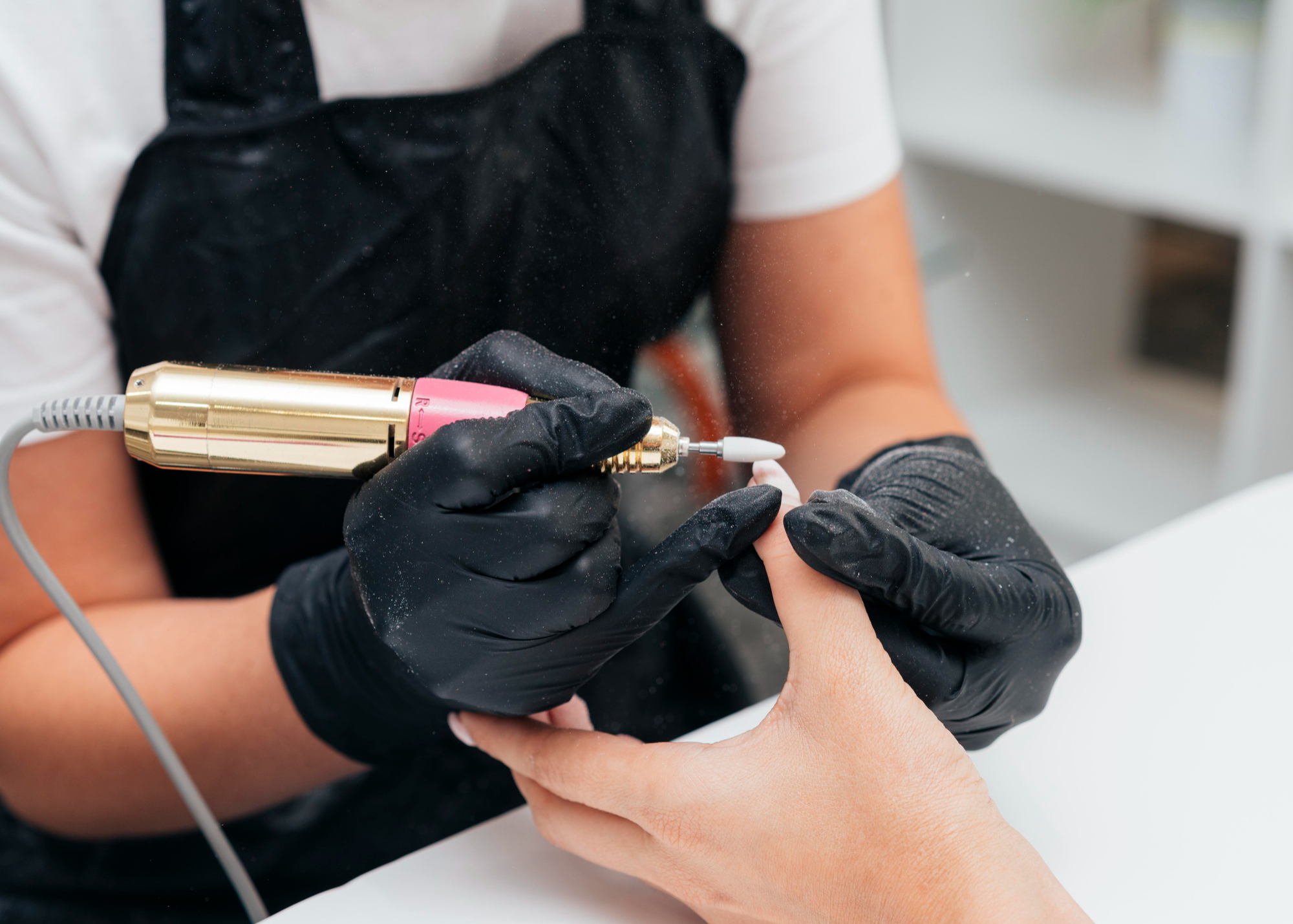
Shellac at a Munich nail salon costs between €25 and €55 per session. Ten clients a week means €1,000–2,200 in gross monthly income. No office rent, no degree, no permit – just the skill and a registered Gewerbe (trade licence).
Germany’s nail services market is one of the largest in Europe and growing steadily. According to market data, the global segment exceeded $11.9 billion in 2023 and is projected to reach $20.3 billion by 2030. Demand for nail technicians in Munich consistently outpaces supply – which directly affects both prices and booking rates.
In this article: real Munich prices, a simple income formula, three scenarios for beginners, and a concrete roadmap from zero to your first earnings. No promises – just figures you can verify.
How Much Does a Manicure Cost in Munich – Real Prices from Salons
Munich ranks among the three most expensive nail service markets in Germany. Below are real prices from Munich studios, verified as of 2024–2025.
| Service | Minimum | Average | Premium |
| Classic manicure | €25 | €35 | €50+ |
| Shellac / Gel polish | €25 | €40 | €55+ |
| Gel extension (new set) | €45 | €65 | €90+ |
| Pedicure | €40 | €55 | €75+ |
Lower end for Shellac from €25; upper end €55+ – premium segment with additional nail art.
The obvious question: «What can I charge as a beginner?» Honest answer: the lower end of the table. Your first months are about building a portfolio and reputation, so €35–40 for Shellac is a realistic starting point. After 2–3 months, most technicians reliably move into the mid-price range – Munich’s market makes that possible.
Don’t try to charge premium prices straight away. Start at the lower end, collect 10–15 reviews, then raise your price by €5 each month – that is the simplest growth strategy.
The Income Formula: How Many Clients Do You Need for a Good Start
A nail technician’s income is simple maths: number of clients × average price. Everything else – material costs, time per client, working days – affects the result, but the core arithmetic is exactly that.
The three scenarios below run from a minimum start to a stable rhythm after three months. The figures assume a mobile or home format with no rental costs.
| Scenario | Clients/week | Avg. price | Gross income/mo. | Costs (~20%) | Net income |
| Minimum start | 5 | €40 | ~€800 | ~€160 | ~€640 |
| Realistic first month | 10 | €45 | ~€1,800 | ~€360 | ~€1,440 |
| After 3 months | 20 | €50 | ~€4,000 | ~€800 | ~€3,200 |
Where do the 20% costs come from? Mainly materials: gel polish, UV lamp, disposable files, sanitiser. The minimum starter kit costs €300–500 – that is your entire start-up capital when working from home. Add minimal marketing: Instagram (free) and occasional paid ads (€20–30/month at first).
If you rent a chair in a salon, add €300–500/month to your costs. You then need 15–17 clients a week instead of ten to reach €1,500 net income.
Start at home or mobile. Renting a salon chair is the next step once you already have a client base and understand your pace.
How to Start Legally – Without the Bureaucratic Nightmare
The key fact: nail design is a non-regulated profession in Germany. No licence, no exam before any authority. The only legal requirement is a registered Gewerbe (trade registration).
Three steps to a legal start:
- Complete a course and get a certificate. The certificate confirms your qualification to clients and the bank.
- Anmeldung (residence registration) – if not done yet. Without it you cannot register a Gewerbe.
- Register your Gewerbe at the Kreisverwaltungsreferat München (KVR) – online or in person. Fee approx. €50; the Gewerbeschein is usually issued on the spot or within a few working days.
After registering your Gewerbe, submit the Fragebogen zur steuerlichen Erfassung (tax registration questionnaire) to the Finanzamt – one form, online.
The most important tax point: Kleinunternehmerregelung (§19 UStG). From 1 January 2025, a two-tier check applies: if your turnover in the previous year was under €25,000 and in the current year stays under €100,000 – you do not charge or pay VAT. For a beginner, this is ideal: less paperwork, less hassle.
On work permits: EU citizens have no restrictions. Ukrainian nationals with temporary protection (§24, extended to March 2027) – self-employment is permitted, as §24 grants unrestricted labour market access including business activity. For your specific situation and documents, check with the Ausländerbehörde.
From deciding ‘I want to try this’ to a legal start: a few days to 2–3 weeks. Course → Gewerbe → first client.
Comparing Work Formats – What Works for the First Year
There are three ways to work as a nail technician in Munich, and each suits a different stage.
| Format | Pros | Cons | Best for |
| Employed (Angestellt) | Stability, clients provided | €2,200–2,500 gross/mo., little freedom | Those who want security |
| Salon chair rental | Higher earnings, own clientele | Fixed costs €300–500/mo. | After building a client base |
| Mobile / home | Zero rental costs | Must find clients independently | Ideal for beginners |
For the first year, the mobile or home format is recommended. Zero overheads, full scheduling freedom, and you choose your own clients and prices. With 10 clients a week at an average of €45, €1,500–2,000 net income is realistic by the second or third month.
Want to add nail extensions and expand your service menu? Check out MONLIS Nail Extension Courses – the logical next step after manicure.
Don’t rush into renting a chair. Build your client base and routine first – then move to a format with fixed costs.
The First Year in Practice – What Typical Experience Shows
The first month is the toughest psychologically. Not because skills are lacking, but because there is no flow yet. The first 5–10 clients are usually friends, acquaintances, colleagues. That is normal. They provide the first reviews that then attract strangers.
MONLIS graduates tell us the same thing: ‘In the first two weeks I thought it wasn’t going to work.’ Then – the first new client. And everything changes.
A typical trajectory: in the first month, 10–15 clients and around €400–600 income. Seems little. But after 3–4 months, with regular Instagram posts and word of mouth, already 50–70 clients and €2,000–2,500 gross income per month.
How to find first clients in Munich – an algorithm that works:
- Ukrainian and Russian-speaking Facebook/Telegram groups in Munich – first 10 clients free or at 50% off in exchange for an honest review.
- Instagram – post your work daily. Hashtags: #nagelstudiomünchen #manikürmünchen – location Munich.
- Google Maps – add a free ‘home technician’ listing via Google Business Profile. Reviews here matter more than on Instagram.
- Referral programme – every satisfied client gets €5 off for bringing a friend. Works better than any paid ad.
Don’t wait for perfect conditions. Your first clients are training and portfolio at the same time. A discounted price at the start pays off in reputation.
From Course to First Income: a 30-Day Roadmap
Munich is one of Germany’s most expensive nail service markets. For the technician, that means higher income potential from the very first weeks.
Concrete roadmap:
- Day 1. Manicure course. One day of training – and you have a certificate, a full set of techniques, and knowledge of materials. MONLIS Manicure Course – 1 day, from €750
- Days 2–3. Starter kit. Buy materials (~€300–400). List provided by the school after the course.
- Days 4–14. Gewerbe + Instagram. Submit the online application (~€50). Simultaneously: first social media posts, announcements in community groups.
- Days 15–30. First clients. 5–10 clients at reduced prices → reviews → first real bookings at full price.
The first month is not about big earnings. It is about building a portfolio, training your speed, and finding your rhythm. Months two and three bring the real numbers.
Check the schedule and book the next course now – places are always limited.
→ MONLIS Manicure Course – 1 day, from €750. You can start earning the very next week. Book the course


