The first day of school. Your daughter holds a bouquet in her new dress, you take photos by the school gate — and ten minutes later you’re back in an empty apartment where, for the first time all summer, no one needs anything from you right now. This isn’t a pause. For some, it’s the chance to find a side job for moms in Munich, a few free hours a week; for others, it’s the push to finally start something new from scratch. For many women in Munich, this exact moment becomes the starting point: a new beauty career in Munich no longer means a year of classes in German or an investment you’re afraid to make — it’s a 1–3 day course you can start this very week. Below: why September works as a psychological trigger for a career change this autumn in Germany, why beauty courses after summer are in such demand, which beauty specialties you can realistically pick up quickly, what it costs, and what you need to know about working legally in Germany.
The September Effect: Why Now Is a Good Time for a New Beauty Career
Psychologists Hengchen Dai, Katherine Milkman, and Jason Riis of the Wharton School analyzed years of behavioral data and identified a pattern they called the fresh start effect (Dai, Milkman, Riis, 2014, Management Science): people are significantly more likely to pursue new goals right after “temporal landmarks” — birthdays, New Year’s, a Monday, or the first day of September.
The mechanism is simple, if not obvious. The researchers explain that such dates prompt people to “take stock of their lives more broadly and step back to consider their big-picture goals” — they psychologically separate their “old self” from a new one, and a decision made right after such a milestone has a better chance of sticking than the same decision made in mid-October.
This is where most people get it wrong: they wait for the “perfect moment,” even though the date itself is already working in their favor. September first isn’t just a school ritual for your daughter or son. It’s the exact kind of landmark your brain automatically registers as a “new chapter” — even if you haven’t been the one going to school for years.
Even when you fully understand that September first is an arbitrary date, the effect still kicks in. The study mentions other similar reference points — a Monday instead of a Tuesday, the first day of the month instead of the last, a birthday instead of an ordinary Tuesday in the middle of the year. Your brain doesn’t ask whether there’s a logical reason for a restart. It’s satisfied by the simple fact of a line between “before” and “after.”
There’s also a very practical factor layered on top of the symbolism: kids being in school means freed-up morning hours, a new daily structure, less chaos. In summer, schedules usually fall apart — camps, trips, kids home all day. In September, the routine comes back — and with it, that same hour or two in the morning or evening that was missing all three months.
It’s exactly this overlap — a symbolic trigger plus genuinely free time — that makes September an unusual window for anyone who’s long been thinking about a career change but keeps putting it off. Usually not for lack of ability: it’s just always “not the right moment.” In September, that argument suddenly stops working.
“I’m Not 20 Anymore” — Is It Really Too Late to Change Careers?
No — and in the beauty industry, age actually works in your favor rather than against you. The German labor market is used to adults retraining: a new career after 30 in Germany — Umschulung — is the norm here, not the exception.
There’s a nuance that’s often overlooked: the beauty industry runs largely on self-employment. A client booking a manicure or brow correction isn’t choosing a specialist’s diploma or years of experience — she’s choosing specific work in a portfolio, tidiness, and how comfortable she feels with that person. Maturity, discipline, and the ability to hold a conversation with a client — exactly what comes with age and experience in other fields — are valued here just as much as technical skill.
The question “will anyone hire me at 35–40 with no beauty experience” is worth reframing. In short-format specialties like nails or lashes, you’re less likely to end up working in someone else’s salon and more likely to build your own practice — and there, what matters isn’t your age on a résumé, but your first five happy clients, who bring you a sixth.
There’s one more thing rarely said out loud: you’ve already survived a move. Anyone who started from zero in a new country, figured out the paperwork, the language, daily life — has exactly the kind of resilience that later helps you get through the first few months of a new venture, when clients are still scarce and doubt shows up every evening. Compared to emigration, a course of a few days isn’t such a frightening step.
The fear usually sounds like this: “what if I start and it doesn’t work out, and I’ve wasted money and time for nothing.” That’s an honest fear, and it shouldn’t be waved away with a line about motivation. But it’s worth weighing against the actual stakes: a short course isn’t a year of your life or a move to another city — it’s a few days and an amount comparable to a month’s worth of small everyday spending. If it doesn’t work out, you’ll have lost less than you think. If it does, you’ll have a profession no one can take from you.
New Beauty Career in Munich: Which Specialties You Can Learn in a Few Days
At MONLIS, that’s four specialties: manicure and nail extensions, lashes, brows, and makeup. All are taught in a 1–3 day format, and most of the course time goes to hands-on practice rather than lectures.
The difference from classic training isn’t just about duration. In the short format, you get exactly as much theory as you need to understand the materials and safety procedures, and spend the rest of the time working with your hands — first on practice hands, then on each other, then on real models. By the end of the course, you already have the first photos of your own work to show potential clients.
Nails
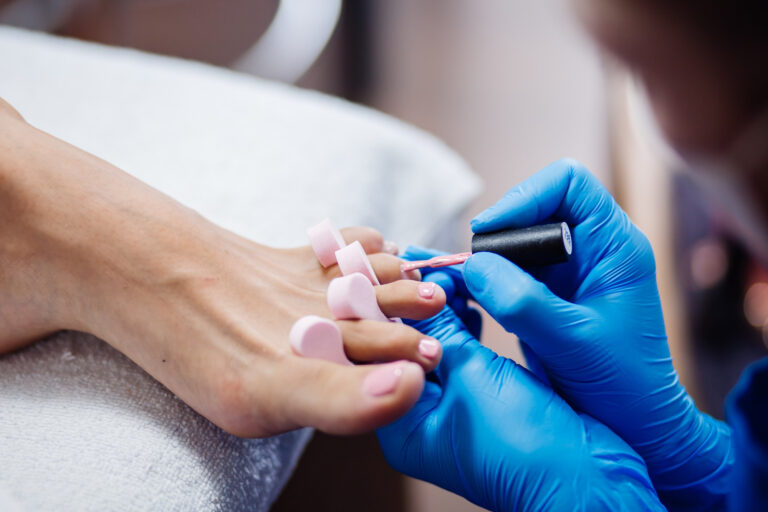
The broadest block of this specialty: basic manicure and pedicure, gel nail extensions, trending nail designs. This specialty has the highest daily demand — people need manicures regularly, not once a season, so your client base builds up faster here than in other specialties. It suits you if you enjoy precise, detailed handwork and are ready for a course longer than a single day — the basic manicure course at MONLIS runs three days, because the technique requires more practice than it seems at first glance.
Lashes
Classic 2D extensions and lash lifting — a fast entry into the profession with relatively low starting costs for materials compared to nail services. The work requires patience: the client lies with her eyes closed for an hour or more while you work with tweezers and microscopic detail. If you enjoy calm, almost meditative work, this specialty often feels easier than the others.
Brows
Brow architecture and lamination are among the shortest courses in format, and you can start practicing on models right away. Demand for this specialty stays consistently high, and the actual client appointment takes less time than lashes or manicure — which matters if you’re planning to combine your new venture with kids or another job.
Makeup
Day and evening makeup, techniques for different face types — a specialty often taken as a second skill alongside lashes or brows rather than a standalone one. The logic is simple: a client whose brows you’ve done is likely to also want makeup for an event — so one visit covers two services instead of one.
If you have no idea where to start, it’s worth checking out the guide to choosing a specialty in the beauty industry on the MONLIS blog — it breaks down which specialty suits which personality type and starting budget.
Approximate MONLIS course prices and durations as of September 2026 (check the catalog for the latest, since some prices go up on October 1):
| Course | Duration | Price now | Price from Oct 1, 2026 |
|---|---|---|---|
| Make-up | 1 day | €230 | €230 |
| Nail service basics | 1 day | €249 | €249 |
| Pedicure | 1 day | €249 | €249 |
| Trending nail designs | 1 day | €249 | €249 |
| Brow architecture | 1 day | €249 | €299 |
| Brow lamination | 1 day | €349 | €400 |
| Lash lamination 2D | 1 day | €350 | €400 |
| Manicure and nail extension course | 3 days | €750 | €750 |
| Nail extensions | 1 day | €750 | €750 |
| Lash extension course | 2 days | €750 | €850 |
For brows, there’s also a separate brow architecture and tinting course — a compact format for anyone who wants to start with this specialty specifically.
Cost and Duration: A Short Course vs. Classic Ausbildung
The difference in numbers looks like this: short MONLIS courses run 1–3 days and €230–750, while a classic Ausbildung in the beauty field (what most people search for on Google as “beauty Ausbildung Munich”) takes 1 to 3 years depending on the training format and federal state, and is taught exclusively in German.
These are fundamentally different formats, and the right way to compare them isn’t “better/worse” but which problem each one solves. A classic Ausbildung gets you a state-recognized certificate and suits you if you’re planning to work in a salon offering a full range of services, or want a long-term career with state-recognized qualification — but it requires one to three years and confident German, and the training is usually built around a broader curriculum rather than one specific specialty.
A short intensive course works differently: you dive straight into one specialty, spend less on the training itself, and walk away with practical skills you can put to use the same week. There are no theoretical blocks on “the history of the profession” or related subjects — just what you’ll actually need with a client. The trade-off is simple: you get to practice faster, but your knowledge stays narrower than after a full Ausbildung.
A MONLIS certificate confirms that you completed the training and practiced under a trainer’s supervision. It’s not a state diploma and doesn’t replace a Meisterbrief — but for basic beauty services in Germany, a state diploma isn’t required either, more on that in the next section. For a client searching for a specialist online, the certificate is what shows up in your profile and removes that first doubt: “does she actually know what she’s doing?”
What You Need to Know About Working Legally in the Beauty Industry in Germany
Here’s the key point, and it’s simpler than it sounds: basic beauty services — manicure, lash extensions, brow shaping, makeup — aren’t a state-regulated profession in Germany. To work for yourself, you need a business registration (Gewerbeanmeldung), not a diploma.
This is the part that scares newcomers the most, even though it’s actually fairly straightforward. Unlike hairdressing, cosmetic services in Germany are classified as zulassungsfreies Handwerk (item 56 on the Anlage B1 list of the Handwerksordnung) — a trade that doesn’t require a mandatory master craftsman exam. To work legally for yourself, you need to register a Gewerbe with your local Gewerbeamt: this is a standard procedure thousands of self-employed people in Germany go through every year, and a formal diploma from a beauty school isn’t a requirement for it.
In practice, the path looks like this: first, a Gewerbeanmeldung at the Gewerbeamt where you live — a standard form and a small fee. As a zulassungsfreies Handwerk, cosmetic services also involve registering with the Handwerkskammer — but without a mandatory Meisterbrief or master exam, unlike, say, hairdressing. It can sound bureaucratically intimidating, but it’s really just two manageable steps — Gewerbeamt and Handwerkskammer — not a year of paperwork.
Hygiene deserves a separate mention — not because it’s a legal requirement for basic services, but because clients and Gesundheitsamt inspections both pay close attention to it either way. Disinfecting tools, using disposable supplies where standard, keeping a tidy workspace — all of this is more about professional reputation than a formal license, but ignoring it means risking both your clients’ health and your own business.
One important caveat: the rule about not needing a diploma applies to basic procedures — manicure, lash extensions, brows, makeup. Procedures that involve breaking the skin (such as permanent makeup or microblading) fall under different, stricter requirements in some federal states — including possible notification to the Gesundheitsamt. It’s best to check the exact conditions for such procedures with your state’s Handwerkskammer or Gesundheitsamt in advance, since requirements vary by region. The MONLIS courses covered in this article don’t fall into that category.
Clients, by the way, still expect proof of skill from a specialist regardless — so the certificate after a course functions here not as a legal requirement, but as a trust signal.
The information in this section is general in nature and does not replace consultation with your local Gewerbeamt, Handwerkskammer, or a lawyer — specific requirements can vary by state and municipality.
The Language Barrier: How to Learn If You Don’t Speak German Yet
At MONLIS, courses are taught in Ukrainian and Russian — one of the few schools in Munich where that’s possible. It’s no surprise that so many people search Google for nail courses in Munich in English — MONLIS fills exactly that kind of need for its own audience.
For most women who’ve recently moved to Germany, language is the main reason a “new career” stays just an idea for so long. Enrolling in a one- to three-year Ausbildung taught in German, when your language level is still B1 or lower, is genuinely hard: you’d have to learn the profession and the language of instruction at the same time.
MONLIS is one of the few schools in Munich where courses run in Ukrainian and Russian. That removes exactly the barrier that usually pushes the decision to “someday, later.” You understand every step the trainer takes right away, without translation and without the fear of missing something during hands-on practice — which matters a lot when you’re working with tools and chemical products.
Picture a lecture in German: you catch half the meaning by ear and piece together the rest from the instructor’s expressions or a classmate’s whispered translation. Now picture a class at MONLIS: the trainer explains the technique in the language you think in, and you can ask follow-up questions without a mental translation delay. The difference isn’t about comfort — it’s about how much actually sticks by the end of the same training day.
That doesn’t mean German won’t matter at all: sooner or later it’ll come in handy for talking with German clients, handling paperwork, and growing your business. But to get started — to walk away with a working skill in a few days — your language level isn’t a barrier here.
The First Step: How to Start This September
Three steps: pick a specialty, sign up for a course, prepare the basic paperwork for your Gewerbe — and in 1–3 days you’ll have a practical skill in hand and a first client in mind.
Here’s how it looks step by step. First, pick a specialty: if you’re not sure, start with what you genuinely enjoy doing with your hands, not what looks “most profitable.” Your motivation through the first practice models and the first tricky clients comes from an actual interest in the process itself.
Next, sign up for a specific course in the MONLIS catalog. Dates are often fixed and spots in each group are limited, since the format is hands-on and trainers give each participant individual attention. The sooner you decide, the better your chances of getting into the date you want this September.
Alongside your training, or right after it, comes a trip to your local Gewerbeamt to register your business — for basic beauty services, that doesn’t require a diploma, just a standard set of documents. And finally, your first client: often a friend, neighbor, or colleague willing to model for a token fee while you build your portfolio and your first work photos for social media. Your second and third clients usually come through a referral from the first.
It’s worth taking care of the visual side from day one: photograph every piece of work for your portfolio and social media — clients choose a specialist based on photos far more than on a diploma. Natural light, a clean background, and a couple of angles do more early on than a professional photo shoot. It’s a habit that’s easier to build in your first week than to make up for a few months in.
There’s also a seasonal factor worth keeping in mind: prices for some MONLIS courses go up starting October 1, 2026. If you’ve already been thinking about this in the fall anyway, September is still your window to lock in the current price and get started while the decision still feels fresh.
Give Yourself Permission for a Fresh Start
September first comes back every year, and every year it means the same thing: not just a new class for your child, but permission for a fresh start for the adult standing beside them. While your daughter or son gets used to a new teacher and a new schedule, you get something that was missing all summer — a free hour in the morning, and the psychological permission to start something of your own.
You don’t have to spend years and learn a new language from scratch to change careers. Sometimes three days of practice, a certificate, and one client willing to trust your hands are enough. There’s no promise of easy success here — the first months after the course will still require work on your portfolio, finding clients, and literally training your hand. But the barrier to entry is much lower than it looks to anyone picturing years of studying in German as the only path into a new profession.
If the September trigger has already kicked in for you and you feel it’s time to act, you can browse all MONLIS courses in the catalog right now, while prices for some specialties haven’t yet gone up on October 1, 2026.
About MONLIS. MONLIS is a hands-on beauty school in Munich, founded in 2020. The school specializes in short intensive courses (1–3 days) in manicure, lash extensions, brow shaping, and makeup, and issues an international certificate after every course. MONLIS is one of the few schools in Munich where training is taught in Ukrainian and Russian, making it the go-to choice for the Ukrainian- and Russian-speaking community in Bavaria looking for a fast, understandable path into a new beauty career.
This article is for informational purposes only and is not a substitute for advice from a doctor or a qualified professional.