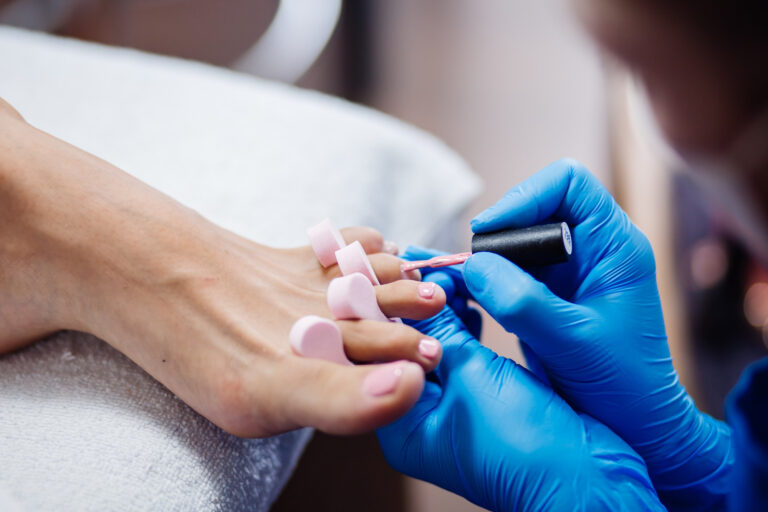
“Online manicure course. Certificate in a few days. Somewhere around €30–80” — you’ve probably seen this ad in Ukrainian and Russian-speaking Munich groups if you’ve ever googled “how to become a nail technician in Germany.” The format really is convenient: a video in the evening after your shift, a quiz, a stamped PDF in your inbox a couple of days later. What to actually do with that piece of paper once your first real client is sitting in front of you, or an employer asks about your experience — the ad never quite explains. Online or in-person manicure course in Germany: the real question isn’t about a convenient schedule, it’s about whether your hands can handle a real nail once there’s no pause button to rewind the video. Live or remote beauty course — the choice comes down to what happens in the first thirty minutes with an actual client, not the diploma on the wall.
What a certificate for manicure work in Germany actually means
A certificate from an online manicure course usually confirms only that you attended the course — not a verified practical skill. The difference matters: a Teilnahmezertifikat, a “certificate of participation,” literally means someone watched the videos and maybe passed an online quiz. Whether that person can hold a drill bit at the right angle, avoid damaging the nail plate, or judge gel polish thickness so the coating doesn’t lift within a week — the document stays silent on all of it.
For employers, and even for clients who just Google a nail technician, the difference between these two kinds of documents is real. According to industry resource elinora.net, serious employers rarely accept purely digital certificates for hands-on roles: sculpting, drill work, nail art. A portfolio of real photos carries almost as much weight as the certificate itself — and there’s no portfolio to build from a video course. The question of recognizing an online certificate is sharper than it looks: even a loudly marketed “international manicure certificate” in practice means only what’s written in the fine print — not an automatic pass with clients or employers.
Manicure business license in Germany (Gewerbe): do you need one if you have a certificate
No — a certificate for completing a course, online or in-person, does not automatically grant permission to open a business in Germany. Completing a course, in any format, is not the same as being allowed to start self-employed work: that’s a separate step, and some online programs never even mention Gewerbe or how the certificate relates to business registration — they simply frame it as “course completed,” full stop.
There’s no simplified answer here like “certificate = permission to work” — and honestly, we wouldn’t want to give one. The exact business classification for a manicure business in Germany (through the IHK or the Handwerkskammer) depends on what your business actually involves, and self-employed beauty professionals often also need to factor in HWK or IHK requirements for cosmetologists — so it’s worth checking directly with the HWK München business start-up advisory service or the IHK in each individual case. What we can say for certain: registering a Gewerbe is a separate step after training, and we have a detailed breakdown on our blog of how to register a Gewerbe after the course, including the Kleinunternehmerregelung.
What an online manicure course really gives you (and what it doesn’t)
An online format handles one job well — theory — and does a poor job at the other — training your hands. That’s worth admitting honestly, because there’s no point pretending video replaces live practice.
The upsides are real. The schedule is yours — you can study at 11pm after a shift at the café, or with a kid nearby. The entry price is lower — by our observation, around €30–80 versus hundreds for an in-person course (for reference: a typical online program like nageldesign-online-ausbildung.de offers packages starting at €79). Materials science, coating types, basic hygiene — all of that can be learned from video just as well as in a classroom, because it’s about memorization, not hand movement.
The downsides are trickier. An online course can teach you what gel polish is made of and how to store it — that’s genuinely convenient and cheap. But you can’t feel the pressure of the tool, the angle of the file, or the thickness of a layer through a screen: hands learn that, not eyes. So a certificate for a few dozen euros and one earned after three days of live practice are, in effect, two different documents.
This is where most beginners get it wrong: they think it’s enough to watch an instructor use a drill on video and repeat the motion at home on themselves. But a mistake in pressure gets corrected in a second by an instructor working with a live model — at home, you might not notice for months that you’re holding the tool at the wrong angle, until a client complains about skin irritation around the nail.
And that’s when the “savings” from the course end up costing more than the price difference: the client goes to another technician, and her impression spreads through the very same chat where she found you in the first place.
Why clients in Munich choose a technician with in-person training
In Munich’s diaspora, the decision to trust someone with your nails is usually made based on a friend’s recommendation and photos of real work, not the name on a certificate. Ask any woman from the Ukrainian or Russian-speaking community how she found her nail technician — the answer is almost always “a friend recommended her” or “I saw it in her stories.”
Clients rarely see the certificate anyway — but they always see photos of finished manicures, often before the first direct message. An online course loses out here not because of teaching quality, but simply because there’s no material to show: three video lessons leave behind no “before/after” shot, while live models on an in-person course leave behind dozens.
For many women building a new profession in a new country, this moment is about more than business. It’s about a fresh start in the beauty industry and that first feeling of “I can actually do this,” which comes from a client’s live reaction to the result — not a score on an online quiz.
Online vs in-person manicure course in Munich: comparison table
The main difference between an online and an in-person manicure course isn’t the price on the website — it’s how much time and hidden cost it takes to reach your first client. Here’s how the two formats stack up, criterion by criterion.
| Criterion | Online Course | In-Person Course (MONLIS) |
|---|---|---|
| Practice on a live model | None or minimal | Yes, under instructor supervision |
| Live instructor feedback | None | Immediate, during the work |
| Portfolio for clients/Instagram | Nothing to build from | Built during the course |
| Time to first client | Months of self-practice | A few weeks after the course |
| Language of instruction | Usually English/German, rarely Russian/Ukrainian (by our observation) | Ukrainian, Russian, German |
| Visible price vs hidden costs | €30–80, plus materials, retraining, fixing mistakes | €750 upfront, materials and practice included |
| Hygiene component | Theoretical, untested in practice | Practiced live with real tools |
When an online format can still make sense
Online makes sense as a supplement after practice, or as a way to refresh theory — materials science, basic hygiene, seasonal design trends — but not as the sole source of hands-on skill. A technician who has already completed in-person training and wants to brush up on a specific topic (say, new gels or this season’s French manicure) can reasonably take a short online module instead of repeating the whole in-person course — it’s faster and cheaper.
Online also suits those who aren’t ready yet to invest in a format with a live model, but want to find out if the profession interests them at all before committing to something bigger. There’s nothing wrong with that — just understand it’s exploration, not a diploma.
How to choose an in-person manicure course in Munich if you need real results
Three criteria show best whether an in-person manicure course will deliver real results: the language of instruction, group size, and what actually stands behind the certificate. Before paying for any course, it’s worth checking each one — not just going by the marketing.
Start with the language of instruction: if you’re still working on your German, training in your native language removes half the stress — you have time to ask questions and understand the nuances of technique instead of mentally translating every word the instructor says. In Munich, a manicure course in Ukrainian or Russian is still rare.
Next — group size. It determines how much attention the instructor can actually give your hands over a few days. In a large group of 15, you can spend half the course waiting your turn for the drill. This is one of the questions asked most often in consultations — and it’s better to verify it in person than by photos on the school’s website.
And most importantly — what’s actually included in the certificate: is it issued after real hands-on practice on models, or just for showing up. MONLIS’s in-person manicure course in Munich runs 3 days (10:00–18:00), with 90% hands-on practice on live models and 10% theory, and results in a MONLIS certificate that confirms a practiced skill — not just attendance in the room.
If a diploma or official recognition of qualification matters to you, it’s worth reading separately: can you work without diploma recognition in Germany. And if you’re still torn between directions — manicure, lashes, brows, or makeup — a comparison of all MONLIS courses by price and duration will help you decide faster.
The question “which course is better” is beside the point here — the two formats solve different problems. Online gives you knowledge you can read and remember. In-person gives you a skill a client will feel with her hands during a manicure and show her friend in her stories.
Online is honest about covering theory. What opens doors in Munich is something else: practice on live models, a portfolio of real work, and the first satisfied clients. If the goal is to earn from doing manicures, not to keep a certificate in a frame, the shortest path there runs through hands-on practice, not one more video lesson watched.
Sign up for the in-person manicure course at MONLIS — 3 days, 90% hands-on practice, a certificate that confirms exactly what you can actually do.
This article is for informational purposes only and does not replace consultation with a doctor or specialist. For questions about registering a Gewerbe, choosing a business category, or HWK/IHK membership, please contact the Handwerkskammer für München und Oberbayern or the relevant IHK directly — this article does not constitute legal advice.