Oksana stood in front of the mirror at the manicure table for about three minutes before picking up the nail file. Not as a client — for the first time, as a technician. Outside was Munich; behind her, a year and a half in Germany without a clear answer to the question “who am I here?” This isn’t a unique story. It’s almost typical: more and more Ukrainian women in Munich are looking for a new career in Germany specifically in the beauty industry — and they’re doing it not out of despair, but deliberately.
Hundreds of thousands of women from Ukraine ended up here without choosing the moment it happened. But one choice remains — who to be next. This article isn’t about how to register a business step by step (though we’ll touch on the Gewerbe, Germany’s business registration, too). It’s about why manicure, lashes, or make-up become the first point of stability for so many — and what that really costs, without any sugarcoating.
A new career in Germany: why the choice increasingly falls on the beauty industry
It’s actually quite simple: this is one of the few fields where the result of your work is visible after just a few days of training — not years.
A medical or law degree from Ukraine has to be recognized here over years — and there’s no guarantee it will be. The official portal for recognizing foreign professional qualifications in Germany explains that for regulated professions this process is handled case by case: the duration and outcome depend on the decision of the responsible authority in each individual case, with no general guarantees. Beauty professions are a different story: you can work as a nail technician or lash artist without a state license — a course and registering as self-employed (Gewerbe) is enough.
There’s a second, less obvious layer to this. A beauty client evaluates the work immediately — by the shape of an eyebrow, by how well a manicure holds up. That’s fast, tangible feedback, something often missing for someone who’s been sending out résumés for months without a reply. And the third reason: demand doesn’t come only from within the diaspora. Bavaria’s Ukrainian community is one of the largest in Germany, according to the Ukrainian Consulate General in Munich, and it grew significantly after 2022 as people fled the war. Service in your native language isn’t a nice bonus — it’s something the market genuinely lacks.
The scale here isn’t abstract. According to Germany’s Federal Office for Migration and Refugees (BAMF, March 2026), around 1.34 million people who entered the country because of the war in Ukraine are currently in Germany under a simplified protection procedure — without an asylum application, and with a work permit. Among them, in the 18–63 age group, are 500,393 women and 349,520 men: women make up nearly 59% of that group. For each of them, the question “what job” sooner or later becomes the question “who am I now.”
Isn’t this just a job out of desperation? That question comes up in almost every conversation on this topic. The honest answer: sometimes, yes. But for a growing number of women, it’s a deliberate calculation — a short entry point, a flexible schedule that can be combined with children or language classes, and a profession that another change in circumstances won’t take away.
A new career as a new identity — what actually changes
A profession becomes a foothold precisely when everything else — home, language, social circle — hasn’t settled yet.
There’s a nuance here that’s easy to miss. This isn’t about therapy, and it isn’t about “healing trauma through work” — the mechanism is simpler. When a person sees the result of their own work every day, and hears about it from someone else, in a new language, a sense of control appears — not global, but local: “I can do something I couldn’t do a month ago.”
Client service is also a person’s first normal social life in a new language. Not an exam, not a job interview, but an ordinary work conversation: “How do you like the shape?”, “Is it too thin?”, “How long will this last?” The language here isn’t learned from a textbook, but in a context that makes sense on its own.
Behind this choice often lies another question: am I not losing my old profession by moving into beauty? There’s no universal answer. But it’s worth separating a profession’s status “on paper” from how much stability it actually provides right now. A former accountant who becomes a lash artist doesn’t stop being someone with a financial education — she adds herself a second path, one that works here and now.
Three stories — three paths into one industry
These are composite portraits reflecting the typical experience of graduates of courses in this format — not the stories of specific people, and not quotes attributed to anyone without their consent.
A former accountant with twelve years of experience — numbers, reports, deadlines — suddenly discovered that none of those skills translate directly into the German job market without her degree being recognized, which would take years. She chose a lash extension course: a short format, her first clients were acquaintances from a chat group for Ukrainians in Munich, and within a few months she had German clients too, through referrals. What changed the most, in her words, wasn’t the income, but the fact that she once again decides for herself — from the start to the end of her workday.
Twenty years in a school. Then evacuation. Then Munich, where her teaching degree would have to be recognized from scratch — and there was neither the time nor the strength for that. This woman taught elementary school and chose manicure — partly because it’s the most “recognizable” field among the people she knew, partly because the training was shorter than the German language courses she was waiting in line for. The first months: anxiety about whether there would be enough clients. Now: a stable schedule and what she herself calls “a habit of normalcy.”
The third story is different. The youngest of the three is a student at a German university, combining her studies with a short make-up course. This isn’t about a crisis or a career change — it’s more of a safety net: uncertainty about finding a job after graduation, and a desire to have “a backup option that actually works right now.” Her perspective is different: not a rescue after a setback, but a deliberate choice to have several sources of stability at once.
What all three have in common isn’t the drama of relocation, but the moment when a profession stops being a temporary solution and becomes something you invest in.
What you actually need to get started — without the sugarcoating
The minimum is simple: a course in a language you understand, a few days of practice, and business registration.
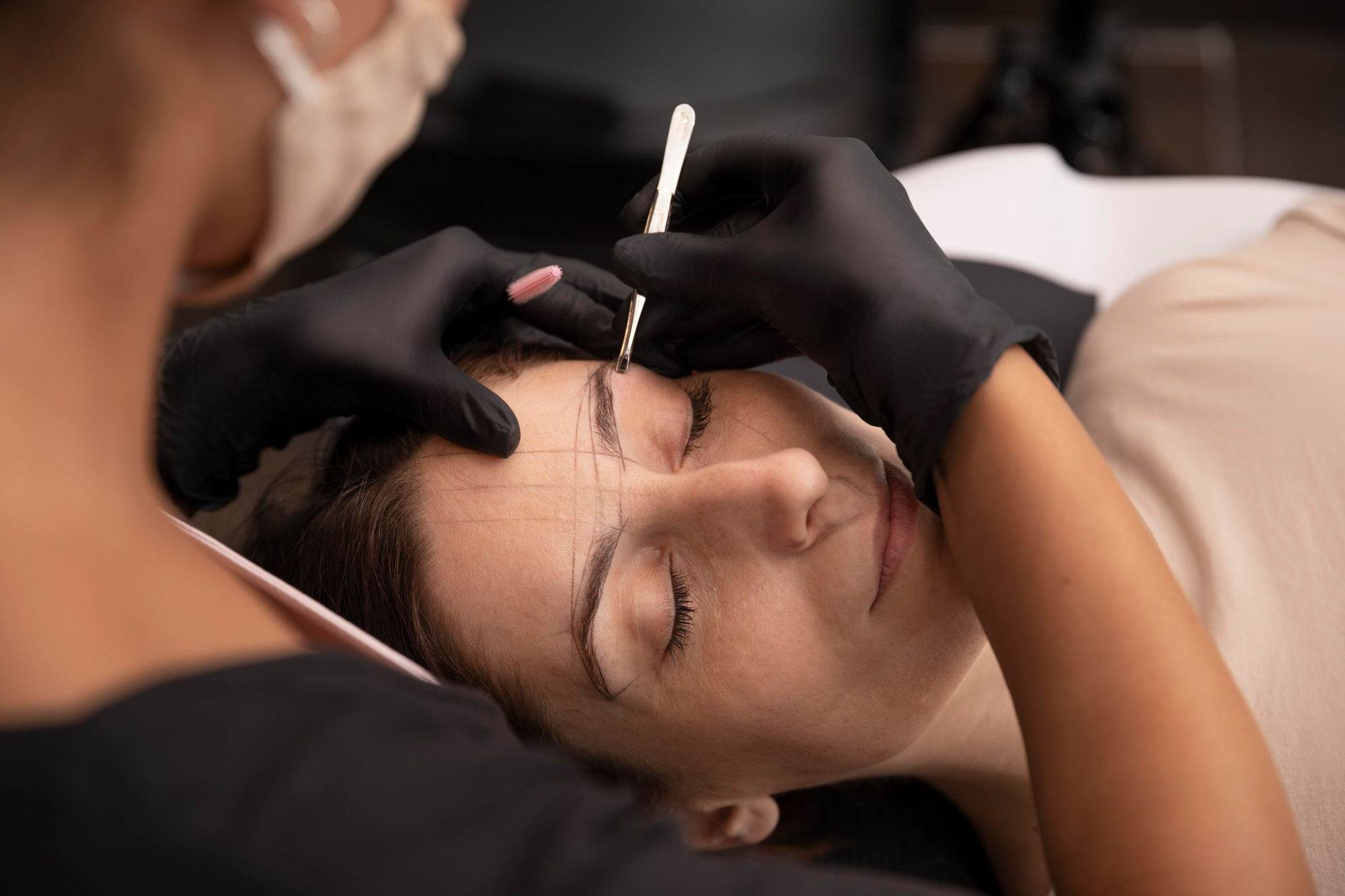
The main obstacle isn’t money or time — it’s language. German beauty schools mostly teach exclusively in German, and for someone who’s just starting to learn the language, that’s a double burden: learning the craft and the language at the same time. That’s why formats that teach in Ukrainian or Russian aren’t a minor convenience — they’re what actually removes the barrier to entry. MONLIS in Munich, for example, builds its courses on this principle: short 1–3 day intensives instead of a year-long program, taught in your native language — covering several fields at once, from manicure and nail extension courses to eyebrow shaping.
The short format isn’t about “simplifying” the craft — it’s about the fact that, for most fields, deep theory isn’t needed at the start: what’s needed is practiced hands, repetition, and feedback from an instructor. The international certificate you get after the course confirms that you completed the training — but it’s not a guarantee of clients and not a substitute for actual practice. In the first months, you’ll still need to build up a portfolio and reputation, often through discounts or working with people you know.
As a concrete plan, it looks roughly like this: pick a field, take a short course in a language you’re comfortable learning in, and, in parallel, sort out business registration — more on that below.
Being honest about the difficulties
The first few months rarely bring a stable income, and without registering a Gewerbe, you can’t legally work independently. This is the section without which the text would turn into pure advertising — and that would go against the whole point of this article.
Income at the start is unstable and usually below the industry average: you have to build your client base from zero, and the first months often go toward discounts, referrals, and building a portfolio. The exact figure depends on the field, the city, and how many hours a technician is willing to dedicate to practice — and any school that promises a specific income as a guarantee is misleading you.
Working independently also requires business registration — a Gewerbe. For beauty services, this is usually registered as a “craft-like trade” (handwerksähnliches Gewerbe): the application is submitted to the local trade office (Gewerbeamt), along with mandatory registration with the Chamber of Skilled Crafts (Handwerkskammer), which comes with a manageable annual fee. No exam or certification is required, but it’s a separate administrative step that the course itself doesn’t cover.
Competition is real too, especially in a big city. Munich isn’t an empty market: dozens of schools and hundreds of technicians work here, and a language advantage gives you a head start, but it doesn’t exempt you from having to build a reputation.
And one more nuance worth understanding from the start: a private school’s certificate isn’t the same as a state license. For unregulated professions, which most beauty fields are, that’s normal and legal. But the difference matters: a certificate confirms completed training, not a monopoly on the profession.
A profession is one of the few choices a person fully controls, even when everything else has changed against their will: the country, the language, the circle of people around them. For some, that choice is a manicure table. For others, it’s lashes or make-up. The difference isn’t in the field — it’s in the moment when the work stops being a temporary solution and becomes something of your own.
If these stories resonated with you, take a look at where you could start: MONLIS course catalog. And you can read more about other fields — manicure, lashes, eyebrows, make-up, careers in Germany’s beauty industry — on the MONLIS blog.
This article is for informational purposes only and does not replace medical or professional advice. The income figures mentioned are rough market estimates, not a guarantee of earnings.
This material was prepared and published by MONLIS school; the article contains links to the school’s own courses.


